How Temperature Affects Biological Wastewater Treatment Performance
Temperature is one of the most influential environmental factors affecting biological wastewater treatment. Every microorganism responsible for removing organic pollutants depends on temperature to regulate metabolism, enzyme activity, reproduction, and overall treatment efficiency. Even when dissolved oxygen, pH, nutrients, and organic loading remain stable, changes in wastewater temperature can significantly alter biological performance.
Unlike mechanical equipment, microorganisms cannot simply be adjusted to operate at maximum efficiency under every condition. As temperatures rise or fall, biological reaction rates change naturally. Some microbial processes accelerate, while others slow dramatically.
Understanding how temperature affects wastewater biology allows operators to anticipate seasonal performance changes, improve process control, reduce sludge accumulation, and maintain more consistent treatment performance throughout the year.
Key Takeaways
Temperature directly affects microbial metabolism, biological reaction rates, organic solids degradation, nutrient removal, and overall wastewater treatment performance. Warmer temperatures generally increase biological activity, while colder temperatures slow microbial growth and pollutant degradation. Maintaining stable operating conditions and understanding seasonal biological changes helps operators optimize long-term wastewater treatment performance.
Why Temperature Matters to Wastewater Biology
Every biological reaction occurring inside a microorganism is controlled by enzymes. Like all enzymes, these biological catalysts function more efficiently within certain temperature ranges. As wastewater temperature changes, enzyme activity changes as well.
When temperatures increase within a favorable range, microorganisms:
- Produce energy more rapidly.
- Consume organic matter faster.
- Reproduce more quickly.
- Degrade pollutants more efficiently.
When temperatures decrease:
- Metabolism slows.
- Cell growth declines.
- Enzyme activity decreases.
- Organic matter degradation becomes less efficient.
Because biological wastewater treatment depends on microorganisms that break down organic waste, even relatively small temperature changes can influence overall treatment performance.
Warm Temperatures Increase Biological Activity
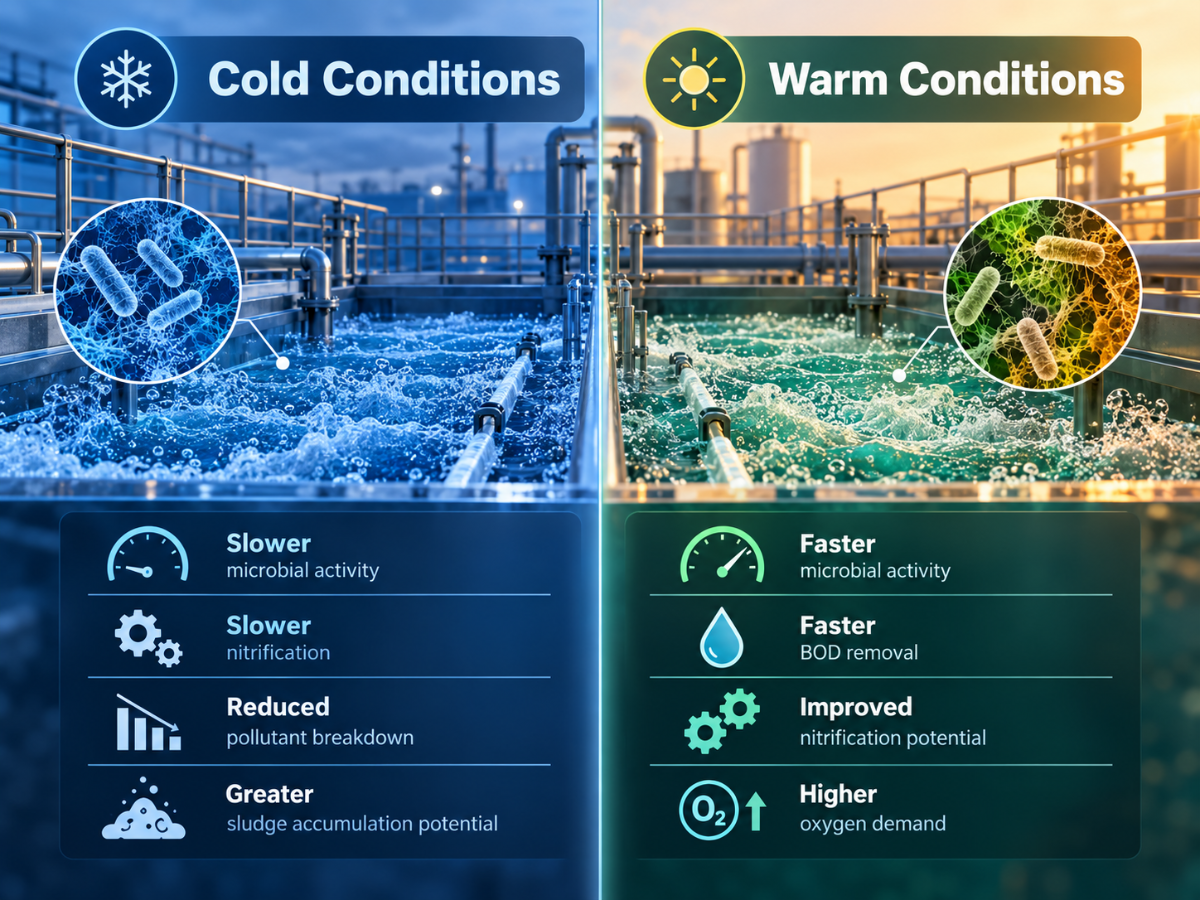
As wastewater temperatures rise within the normal operating range, microbial activity generally increases. Microorganisms become more metabolically active, allowing them to consume organic pollutants at faster rates.
Benefits of warmer biological conditions often include:
- Faster BOD removal
- Faster degradation of biodegradable COD
- Increased biomass growth
- Faster startup of biological systems
- More rapid recovery following biological upsets
However, higher temperatures are not always beneficial. As biological activity increases, microorganisms consume oxygen more rapidly while warmer water simultaneously holds less dissolved oxygen. Without adequate aeration, this increased oxygen demand may create biological stress despite the higher metabolic rate. Operators should therefore evaluate dissolved oxygen alongside temperature rather than viewing temperature independently.
Cold Temperatures Slow Biological Processes
As wastewater temperatures decline, biological treatment naturally becomes less efficient. Lower temperatures reduce enzyme activity, slowing nearly every biological process responsible for wastewater treatment. Many wastewater microorganisms remain viable as temperatures decline, but their metabolic activity and growth rates slow considerably.
Cold temperatures commonly result in:
- Slower BOD removal
- Reduced COD degradation
- Lower biomass growth
- Slower nitrification
- Greater potential for net sludge accumulation as biological degradation slows
- Longer startup periods
- Reduced biological recovery rates
These seasonal changes are particularly noticeable in outdoor systems, where cold weather impacts wastewater lagoon performance as water temperatures follow changing seasonal conditions. Operators should expect seasonal biological variation rather than interpreting every winter performance decline as a treatment failure.
Temperature and Dissolved Oxygen Work Together
Temperature and dissolved oxygen are closely connected in biological wastewater treatment. As wastewater warms, microbial activity increases and oxygen demand rises. At the same time, warmer water naturally holds less dissolved oxygen. This combination creates one of the most common summertime biological challenges.
Higher temperatures may produce:
- Increased biological oxygen demand
- Faster microbial respiration
- Lower dissolved oxygen concentrations
- Greater potential for odor formation
- Increased risk of localized anaerobic conditions
If oxygen demand begins to exceed oxygen availability, low-oxygen conditions can also contribute to industrial lagoon odors and localized anaerobic conditions. Operators often notice these effects during the summer months when treatment systems experience higher biological activity but reduced oxygen availability. Monitoring dissolved oxygen becomes especially important during periods of elevated wastewater temperatures.
Temperature and Nitrification
Among all biological wastewater processes, nitrification is particularly sensitive to temperature. The specialized bacteria responsible for converting ammonia into nitrate reproduce much more slowly than many other wastewater microorganisms. As temperatures decline, nitrification slows significantly.
Operators may observe:
- Elevated ammonia concentrations
- Reduced nitrogen removal
- Slower biological recovery
- Longer startup periods
Within favorable biological ranges, warmer temperatures generally increase nitrification rates, provided sufficient dissolved oxygen and other required conditions remain available. Because nitrifying bacteria are both temperature-sensitive and slow-growing, maintaining stable operating conditions is essential for consistent nitrogen removal.
Temperature and Sludge Production
Temperature also influences how quickly microorganisms degrade organic solids. During warmer conditions, microorganisms convert a greater percentage of incoming organic matter into carbon dioxide, water, and new biomass. During colder periods, biological degradation slows.
As a result:
- More organic material remains partially degraded.
- Sludge accumulates more rapidly.
- Lagoon capacity gradually decreases.
- Sludge hauling or dredging requirements may increase over time.
Facilities operating wastewater lagoons often experience the greatest seasonal differences because biological activity depends almost entirely on natural environmental conditions. Understanding these seasonal trends can help operators develop strategies to reduce sludge in wastewater lagoons and protect long-term treatment capacity.
Sudden Temperature Changes Create Biological Stress
While microorganisms can gradually adapt to seasonal temperature changes, rapid temperature shifts are much more stressful.
Examples include:
- Hot process water entering cool treatment systems
- Cold weather following warm operating conditions
- Batch discharges with significantly different temperatures
- Equipment failures affecting process heating or cooling
Rapid temperature changes can disrupt acclimated microbial communities and temporarily reduce biological treatment efficiency while the population adjusts to the new conditions. Temperature shock is one of several operating conditions that can contribute to biological upsets in wastewater treatment systems. This temporary stress often reduces biological efficiency even though the microbial population remains healthy. Maintaining consistent wastewater temperatures whenever practical helps minimize biological stress and improve long-term treatment stability.
Industrial Wastewater Often Experiences Greater Temperature Variation
Industrial wastewater can experience significant temperature fluctuations because production and cleaning processes may introduce wastewater at very different temperatures.
Facilities commonly experiencing significant temperature changes include:
- Food processors
- Meat processing facilities
- Breweries
- Dairies
- Chemical manufacturers
- Rendering plants
- Beverage manufacturers
Sources of temperature variation may include:
- Clean-in-place (CIP) systems
- Heated processing equipment
- Seasonal production changes
- Hot water cleaning
- Cooling water discharges
- Outdoor equalization basins
Understanding where these temperature changes originate helps operators identify opportunities to improve biological stability before treatment performance declines.
How Operators Can Manage Temperature-Related Challenges
Although operators cannot control seasonal weather, they can manage many of the operating conditions that influence biological performance during temperature changes. Successful temperature management focuses on maintaining biological stability rather than attempting to eliminate every seasonal fluctuation.
Best practices include:
- Monitor wastewater temperature routinely.
- Track dissolved oxygen more frequently during warm weather.
- Anticipate slower biological activity during colder months.
- Avoid sudden temperature swings whenever possible.
- Equalize hot or cold process discharges before biological treatment.
- Monitor sludge accumulation seasonally.
- Adjust aeration to meet changing oxygen demand.
- Review seasonal performance trends to identify recurring patterns.
Facilities that anticipate temperature-related changes are better prepared to maintain stable biological treatment throughout the year.
Recovering from Temperature-Related Biological Stress
When temperature changes contribute to declining biological performance, the most effective response is restoring stable operating conditions.
Operators should evaluate:
- Influent wastewater temperature
- Dissolved oxygen trends
- Organic loading
- Recent production changes
- pH stability
- Nutrient availability
- Sludge accumulation
- Equipment performance
Attempting to force biological recovery through aggressive process changes often creates additional stress for the microbial community. Instead, maintaining consistent environmental conditions allows microorganisms to gradually adapt and restore biological activity naturally. In situations involving significant biological stress, bioaugmentation may help supplement beneficial microorganisms while the biological community reestablishes itself under favorable operating conditions.
The Bottom Line
Temperature influences nearly every aspect of biological wastewater treatment. By affecting microbial metabolism, enzyme activity, dissolved oxygen demand, nitrification, sludge degradation, and biological recovery, temperature plays a central role in overall treatment performance. Warm temperatures generally accelerate biological activity but increase oxygen demand, while cold temperatures slow microbial metabolism and reduce pollutant degradation. Sudden temperature changes create additional biological stress by forcing microorganisms to adapt before they can efficiently treat wastewater.
Facilities that understand these biological responses and proactively adjust operations as conditions change are better equipped to maintain consistent treatment performance, reduce sludge accumulation, improve nutrient removal, and minimize seasonal operational problems. Temperature cannot be controlled outdoors, but its impact on wastewater biology can be successfully managed through sound biological process control.
Frequently Asked Questions
How does temperature affect biological wastewater treatment?
Temperature affects microbial metabolism, enzyme activity, pollutant degradation, sludge production, and nutrient removal. Warmer temperatures generally increase biological activity, while colder temperatures slow biological reactions.
Why does wastewater treatment slow during winter?
Cold temperatures reduce enzyme activity and microbial metabolism. As biological reactions slow, microorganisms require more time to break down organic pollutants, leading to reduced treatment efficiency and increased sludge accumulation.
Does warm wastewater always improve treatment?
Not necessarily. Although warmer temperatures increase microbial activity, they also reduce dissolved oxygen concentrations while increasing oxygen demand. Without adequate aeration, treatment performance may actually decline.
How does temperature affect nitrification?
Nitrifying bacteria are especially sensitive to temperature changes. Cold temperatures significantly slow ammonia conversion, while warmer temperatures generally improve nitrification if sufficient dissolved oxygen is available.
Can operators prevent temperature-related biological problems?
Operators cannot control seasonal temperatures, but they can reduce biological stress by maintaining adequate dissolved oxygen, minimizing rapid temperature fluctuations, monitoring seasonal trends, and maintaining stable operating conditions.
Request a Free Technical Wastewater Assessment
Seasonal temperature changes can significantly affect biological wastewater treatment. If your facility is experiencing reduced treatment performance, excessive sludge accumulation, recurring odors, or seasonal biological instability, Drylet's technical team can evaluate your system and recommend practical biological treatment strategies.
Request a Free Technical Assessment
See Real-World Wastewater Case Studies
Explore real-world examples of sludge reduction, lagoon capacity recovery, biological treatment performance, and operating cost improvements using Drylet treatment programs.
View Wastewater Treatment Case Studies
Interested in Becoming a Drylet Distributor?
Drylet is expanding its distributor network across industrial wastewater, food processing, agriculture, rendering, FOG, and wastewater treatment markets. Join a growing network delivering science-based biological treatment solutions.