Common Wastewater Microorganisms: What They Do and What They Reveal About Treatment Health
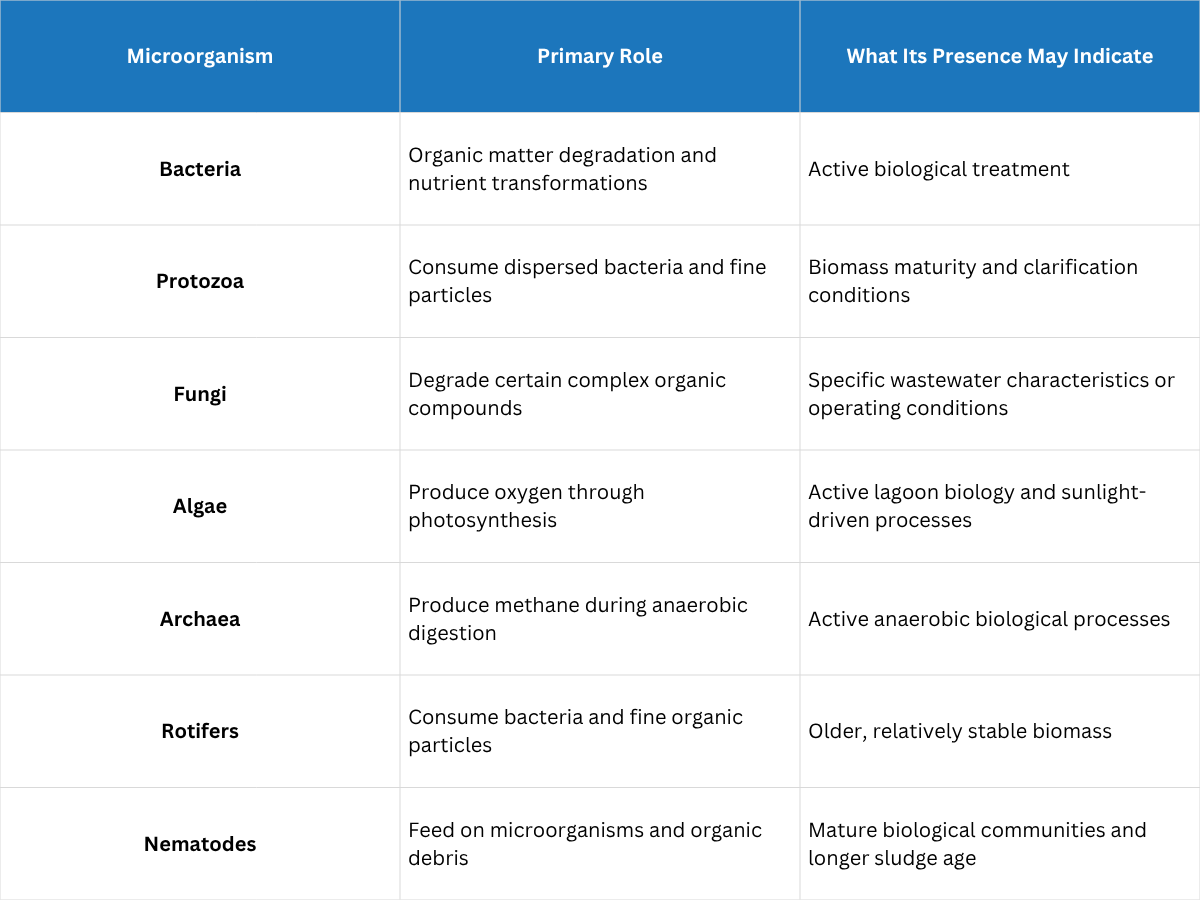
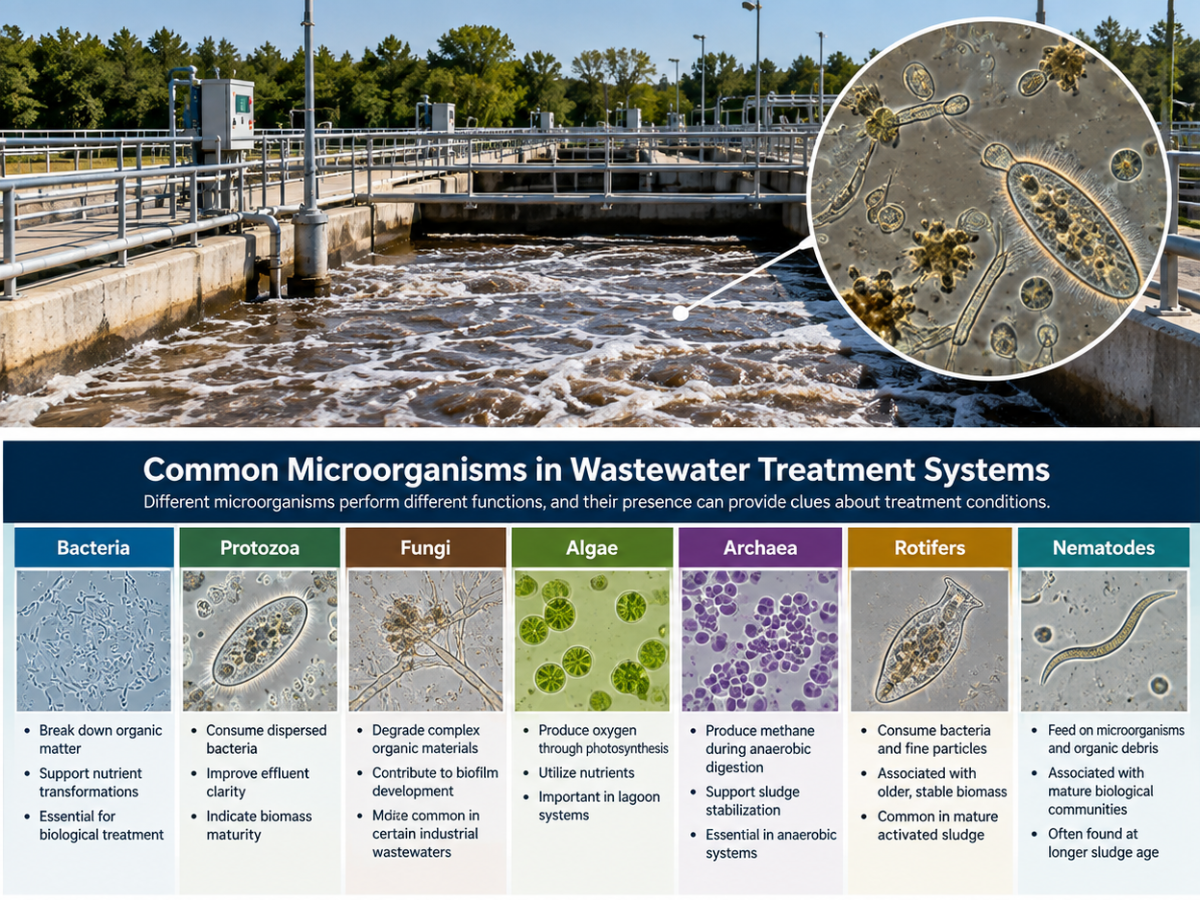
Biological wastewater treatment systems contain far more than bacteria. Beneath the surface is a diverse population of bacteria, protozoa, fungi, algae, archaea, rotifers, nematodes, and other microscopic organisms. Each group performs different functions. Some organisms break down organic matter, some consume dispersed bacteria and fine particles, some support nutrient cycling, and others can provide clues about the age and stability of the biological population.
Identifying the organisms present in a wastewater treatment system can help operators better understand biological conditions, troubleshoot changes in performance, and recognize signs of a mature or stressed microbial community. This guide explains the most common groups of wastewater microorganisms, what they do, and what their presence may reveal about treatment health.
Key Takeaways
Wastewater treatment systems contain many different types of microorganisms, each with specialized biological roles. Bacteria perform most organic matter degradation, while protozoa, fungi, algae, archaea, rotifers, nematodes, and other organisms contribute to clarification, nutrient cycling, anaerobic digestion, solids stabilization, and overall biological balance.
The organisms present in a system can also provide useful clues about treatment conditions, particularly in activated sludge, lagoon, and anaerobic treatment processes.
What Microorganisms Can Reveal About Treatment Health
The microbial population in a wastewater treatment system changes as operating conditions change. Temperature, dissolved oxygen, organic loading, pH, nutrient availability, sludge age, toxicity, and other environmental conditions can influence which organisms become dominant. For this reason, microscopic observations can provide operators with another source of information about biological treatment conditions.
Changes in microbial populations can also help operators investigate biological upsets in wastewater treatment systems:
- Changes in organic loading
- Shifts in sludge age
- Poor settling conditions
- Low dissolved oxygen
- Biological stress
- Changes in treatment stability
Microorganism observations should be considered alongside operating data such as dissolved oxygen, pH, temperature, loading, and effluent quality rather than used as a stand-alone diagnosis. For a deeper look at how microbial community diversity affects biological treatment stability, see our guide to microbial communities in wastewater treatment.
Bacteria
Bacteria are the primary biological workforce in most wastewater treatment systems. They perform the majority of organic matter degradation by consuming dissolved and suspended pollutants as food.
Different bacterial groups specialize in different biological functions, including:
- Organic matter degradation
- Nitrification
- Denitrification
- Sludge stabilization
- Biofilm formation
- Nutrient cycling
Because bacteria perform so many essential biological functions, major changes in bacterial activity can quickly affect treatment performance.
Protozoa
Protozoa are single-celled microorganisms that primarily feed on bacteria and small suspended particles. Although they remove relatively little organic matter directly, they play an important role in maintaining biological balance.
Healthy protozoan populations help:
- Improve effluent clarity
- Reduce dispersed bacteria
- Improve sludge settling
- Indicate biological stability
Different types of protozoa are often observed during microscopic examinations of activated sludge. Their relative abundance and type can provide clues about organic loading, sludge age, settling conditions, and overall biological stability. Protozoa should therefore be viewed not only as members of the treatment community, but also as potential biological indicators of changing process conditions.
Fungi
Fungi specialize in degrading complex organic materials that many bacteria digest more slowly. Fungi can play an important role in wastewater containing complex organic materials such as cellulose, lignin, wood fibers, and other compounds that may degrade more slowly.
Although fungi are typically less abundant than bacteria, they contribute to:
- Complex organic matter degradation
- Biofilm development
- Organic solids stabilization
- Nutrient recycling
Fungal populations become particularly valuable in certain industrial wastewater applications where unusual organic compounds are present. The abundance of fungi can also change in response to wastewater characteristics and operating conditions, making their presence another useful observation when evaluating the biological community.
Algae
Algae play an especially important role in wastewater lagoons. During daylight hours, algae perform photosynthesis, producing oxygen that supports aerobic bacterial activity near the lagoon surface. This natural oxygen production reduces reliance on mechanical aeration in many facultative lagoon systems.
In addition to oxygen production, algae contribute to:
- Carbon dioxide utilization
- Nutrient uptake
- Surface biological activity
- Lagoon ecosystem stability
Healthy algae populations often support improved biological treatment during warmer months when sunlight is abundant. However, excessive algal growth can also contribute to significant daily changes in dissolved oxygen and pH. Algae should therefore be evaluated as part of the overall lagoon ecosystem rather than viewed as universally beneficial.
Archaea
Although often confused with bacteria, archaea are a separate group of microorganisms with unique biological characteristics. Archaea play a critical role in anaerobic wastewater treatment by converting intermediate organic compounds into methane and carbon dioxide during anaerobic digestion. Methanogenic archaea perform the final biological step in anaerobic digestion, producing methane from intermediate organic compounds.
These microorganisms contribute to:
- Methane generation
- Sludge stabilization
- Volatile solids reduction
- Renewable energy production
- Anaerobic digestion efficiency
Because methanogens grow slowly and are highly sensitive to environmental changes, maintaining stable biological conditions is essential for successful anaerobic treatment.
Rotifers
Rotifers are microscopic multicellular organisms commonly found in mature activated sludge systems and stable biological treatment processes. Unlike bacteria and protozoa, rotifers feed on suspended bacteria, algae, and fine organic particles.
In activated sludge systems, their presence is commonly associated with:
- Mature biological treatment
- Stable microbial populations
- Longer sludge age
- High effluent quality
Rotifers are commonly associated with older, more established biomass and can provide another useful clue about sludge age and biological maturity.
Nematodes
Nematodes are tiny roundworms occasionally observed in biological wastewater treatment systems. Like rotifers, they generally appear in older, well-established biological communities. Nematodes consume bacteria, protozoa, and organic debris while contributing to nutrient recycling within the biological ecosystem.
Although they contribute little directly to pollutant removal, their presence may be associated with::
- Stable biological conditions
- Mature sludge
- Long sludge age
- Established microbial communities
Microscopic identification of nematodes may provide additional information regarding biological process health.
How Wastewater Microorganisms Interact
Perhaps the most important concept in biological wastewater treatment is that these microorganisms rarely function independently. Instead, they form highly cooperative biological communities.
Within a healthy treatment system:
- Bacteria degrade organic pollutants.
- Protozoa regulate bacterial populations.
- Fungi digest complex organic compounds.
- Algae produce oxygen in lagoon environments.
- Archaea generate methane during anaerobic digestion.
- Rotifers and nematodes help recycle nutrients and maintain biological balance.
These interactions help create a biological treatment system capable of responding to changing wastewater conditions. Understanding how wastewater biology drives treatment performance allows operators to interpret the treatment process as a living system rather than simply a collection of mechanical equipment.
Why Operators Should Understand Wastewater Microorganisms
Most wastewater operators never see the organisms performing biological treatment without microscopic examination, yet nearly every operating decision affects their environment.
Understanding common wastewater microorganisms can help operators:
- Interpret changing biological conditions
- Investigate treatment upsets
- Evaluate sludge settling characteristics
- Recognize changes in biomass maturity
- Better understand nutrient removal
- Identify early signs of biological stress
Microscopic observations become especially useful when combined with process data such as dissolved oxygen, temperature, pH, loading, sludge age, and effluent performance. These observations are especially useful when evaluated alongside changes in biomass health and activity. Wastewater treatment is not simply the management of pumps, tanks, and aeration equipment. It is also the management of a living biological population.
The Bottom Line
Biological wastewater treatment contains an entire community of microorganisms with different jobs and different responses to operating conditions. Bacteria perform most organic matter degradation, protozoa help control dispersed bacteria and improve clarification, fungi contribute to the degradation of complex organics, algae influence lagoon biology, archaea support anaerobic digestion, and organisms such as rotifers and nematodes can provide clues about biomass maturity.
No single microorganism tells the entire story. However, understanding which organisms are present and how their populations change can give operators valuable insight into biological treatment conditions. Combined with routine operating data, microbial observations can help facilities recognize changing conditions earlier and make more informed biological process decisions.
Frequently Asked Questions
What microorganisms are found in biological wastewater treatment?
Biological wastewater treatment commonly contains bacteria, protozoa, fungi, algae, archaea, rotifers, nematodes, and numerous other microorganisms that work together to remove pollutants and stabilize wastewater.
Which microorganisms are most important?
Bacteria perform most of the biological treatment by degrading organic matter. However, healthy wastewater treatment depends on the combined activity of many different microorganisms rather than bacteria alone.
Why are protozoa important?
Protozoa consume dispersed bacteria and suspended particles, helping improve effluent clarity, sludge settling, and overall biological stability. Their presence is often an indicator of a healthy treatment process.
What role do archaea play?
Archaea are essential in anaerobic treatment systems. Methanogenic archaea convert intermediate organic compounds into methane and carbon dioxide during anaerobic digestion, supporting renewable biogas production and sludge stabilization.
Can microorganisms be used to diagnose wastewater treatment problems?
Microorganisms can provide useful clues about biological conditions, but they should not be used alone to diagnose treatment problems. Microscopic observations are most valuable when evaluated alongside dissolved oxygen, pH, temperature, loading, sludge age, settling characteristics, and effluent data.
Request a Free Technical Wastewater Assessment
Healthy microbial communities are the foundation of effective biological wastewater treatment. If your facility is experiencing excessive sludge accumulation, biological instability, recurring odors, or declining treatment performance, Drylet's technical team can evaluate your wastewater system and recommend science-based biological treatment strategies.
Request a Free Technical Assessment
See Real-World Wastewater Case Studies
Explore real-world examples of sludge reduction, biological treatment performance, lagoon capacity recovery, and operating cost improvements using Drylet treatment programs.
→ View Wastewater Treatment Case Studies
Interested in Becoming a Drylet Distributor?
Drylet is expanding its distributor network across industrial wastewater, food processing, agriculture, rendering, FOG, and wastewater treatment markets. Join a growing network delivering proven biological treatment solutions.