Commercial Grease Trap Maintenance: A Complete Guide to FOG Management
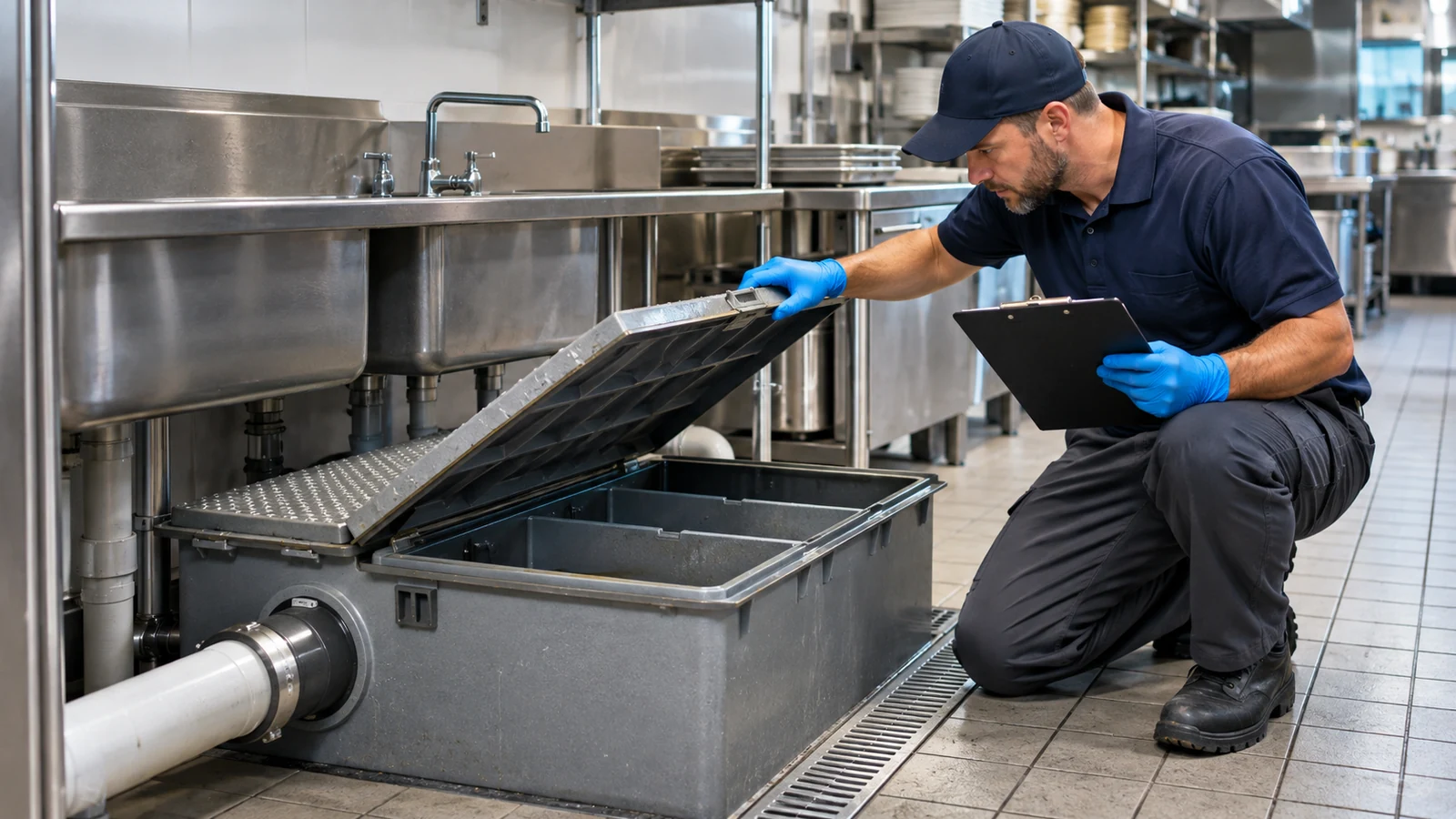
Commercial kitchens generate fats, oils, and grease (FOG) every day. Without effective grease management, these materials can accumulate in plumbing systems, restrict wastewater flow, create persistent odors, and contribute to expensive drain backups.
A properly maintained grease trap or grease interceptor helps capture FOG before it reaches the public sewer system. But installing the equipment is only the beginning. Long-term performance depends on proper sizing, routine inspection, timely cleaning, employee practices, and an understanding of how grease behaves in wastewater.
Commercial grease trap maintenance is not simply about removing accumulated grease. It is about preventing operational disruptions, protecting downstream infrastructure, and meeting applicable wastewater discharge requirements.
This guide explains how grease traps work, what causes them to lose efficiency, how to determine appropriate cleaning intervals, and how biological treatment—including Drylet's patented microbial carrier technology—can fit into a comprehensive FOG management program.
Key Takeaways
- Grease traps and interceptors separate free-floating FOG and settleable solids from commercial kitchen wastewater.
- Maintenance frequency depends on equipment design, grease loading, local regulations, and operating conditions.
- Excessive grease and solids accumulation reduces effective storage and can increase grease carryover, odors, and drain backups.
- Source control, employee training, inspection, complete cleaning, and documentation form the foundation of effective FOG management.
- Carrier-based biological treatment may support organic grease and odor management where permitted, but does not replace required cleaning or compliance obligations.
What Is a Commercial Grease Trap?
A commercial grease trap is a plumbing device designed to capture fats, oils, grease, and some settleable solids from wastewater generated by food service operations.
Restaurants, hotels, institutional kitchens, cafeterias, and commercial food preparation facilities use grease separation equipment to limit the amount of FOG entering sewer systems.
FOG enters kitchen wastewater through activities such as:
- Washing cookware, dishes, and food preparation equipment
- Cleaning grills, fryers, and cooking surfaces
- Handling meat, dairy products, sauces, and other fatty foods
- Washing grease-coated equipment and kitchen floors
- Allowing food particles and oily residues to enter sinks or floor drains
As wastewater temperature and flow conditions change, some fats and oils separate from water, adhere to plumbing surfaces, or collect inside grease separation equipment. Over time, the resulting deposits can reduce flow and create additional maintenance problems.
For a closer look at downstream impacts, read Why FOG (Fats, Oils, and Grease) Disrupts Wastewater Treatment Systems.
Grease Trap vs. Grease Interceptor: What's the Difference?
The terms grease trap and grease interceptor are often used interchangeably, but the equipment can differ substantially in design and application.
Hydromechanical grease interceptors (HGIs) are commonly compact devices installed near kitchen fixtures. They use engineered flow-control and separation features and have manufacturer-specific rated capacities.
Gravity grease interceptors (GGIs) are typically larger tanks, often installed underground outside the building. Their volume and internal arrangement help provide time and conditions for grease to separate by gravity.
Both are intended to limit FOG discharge. Proper selection depends on fixture flow, expected grease loading, equipment design standards, maintenance access, and local plumbing and wastewater requirements.
How Does a Commercial Grease Trap Work?
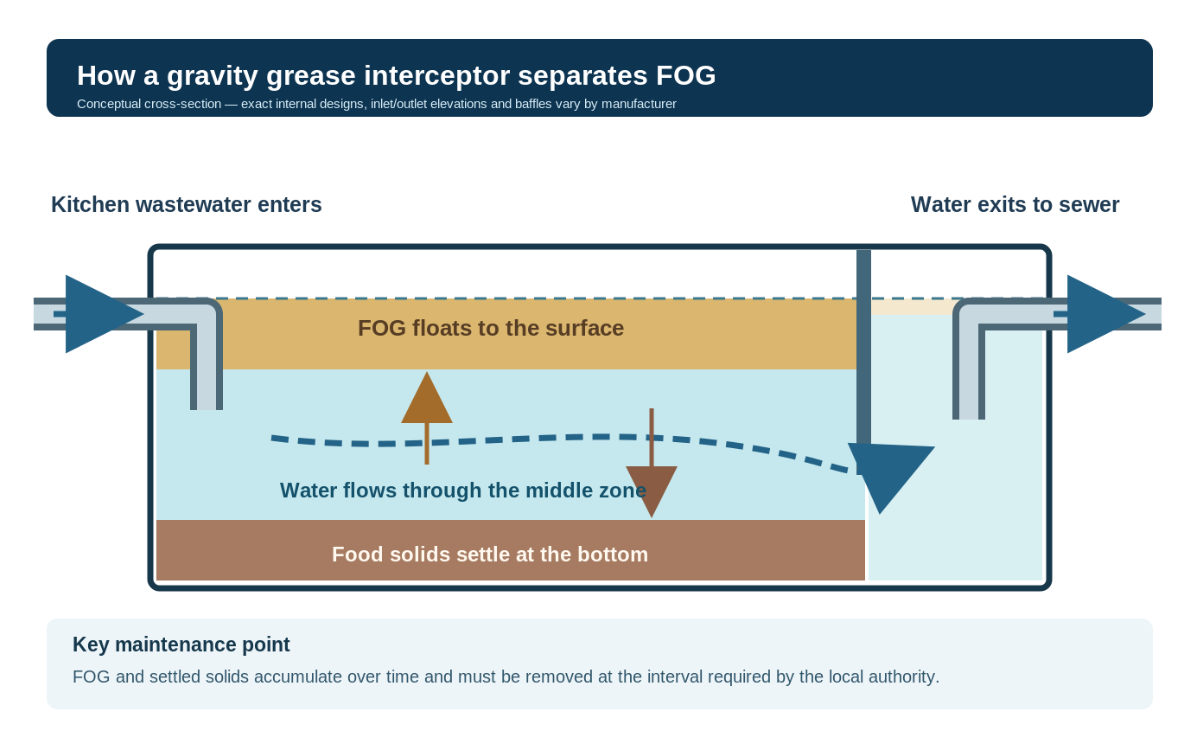
Grease separation depends on density differences, controlled flow, and adequate conditions for FOG and solids to separate from the wastewater.
1. Grease-Containing Wastewater Enters
Wastewater from designated kitchen fixtures enters the device carrying water, food residues, suspended solids, and fats, oils, and grease. The interceptor is designed to control hydraulic conditions so separation can occur without excessive turbulence.
2. FOG Rises Toward the Surface
Many free fats and oils are less dense than water and rise under suitable conditions. A floating grease layer gradually develops. Emulsified grease and very small droplets may be more difficult to capture, especially when detergents, high flow, or excessive temperature interfere with separation.
3. Heavier Solids Settle
Settleable food particles and other solids accumulate on the bottom. These materials occupy storage volume and can create additional maintenance demands. Gravity separation does not remove all dissolved or suspended organic material.
4. Wastewater Exits Through the Outlet
Properly configured baffles and outlet arrangements help draw water from below the floating grease layer and above settled solids. As material accumulates, effective storage and separation performance can decline, increasing the risk of FOG carryover.
The U.S. Environmental Protection Agency's FOG pretreatment fact sheet explains why controlling grease at food service establishments is important for preventing sewer blockages and protecting downstream wastewater infrastructure.
Why Commercial Grease Trap Maintenance Matters
A grease trap is designed to accumulate grease and solids. Maintenance is therefore part of normal operation, not simply a response to an emergency.
Reduced Separation Efficiency
As grease and solids occupy more space, the interceptor has less effective capacity for incoming flow. Under unfavorable conditions, grease can escape into downstream plumbing.
Drain Backups and Plumbing Restrictions
Escaped grease may accumulate in pipes where wastewater cools or slows. Deposits can gradually narrow flow passages, contribute to recurring clogs, and ultimately lead to backups or emergency service calls.
Persistent Grease Trap Odors
Accumulated organic material can decompose in low-oxygen zones. Under some conditions, microbial activity produces hydrogen sulfide and other odor-causing compounds. Damaged covers, failed seals, dry traps, and ventilation problems can also create odors, so the cause should be diagnosed rather than assumed.
Higher Operating Costs
Poor grease management may lead to emergency drain cleaning, hydro-jetting, repairs, additional service calls, lost kitchen operating time, and regulatory violations. The cost of a recurring problem may be much greater than scheduled preventive maintenance.
How Often Should a Commercial Grease Trap Be Cleaned?
There is no universal cleaning interval appropriate for every food service establishment. The right schedule depends on grease loading, equipment capacity, manufacturer recommendations, maintenance history, and—most importantly—local requirements.
A high-volume kitchen producing substantial grease may require more frequent service than a lower-volume operation with larger equipment. Inspection measurements and cleaning records help operators identify whether their schedule is adequate.
Understanding the 25% Rule
Many wastewater authorities use a 25% accumulation threshold for grease and settled solids, but the precise measurement and mandatory cleaning intervals vary by jurisdiction and device.
As one example, Salt Lake City Public Utilities' FOG program states that:
- Hydromechanical grease interceptors must be completely cleaned at least every 30 days, and sooner when needed to stay below the city's accumulation limit.
- Gravity grease interceptors must be cleaned at least every 90 days or when grease and solids reach 25% of the capacity on the inlet side (first chamber), whichever occurs first.
These are Salt Lake City's requirements not universal national cleaning intervals. Other authorities use different criteria, and a local minimum service frequency still applies even if accumulation is below the threshold.
What Influences Cleaning Frequency?
- Meals served and kitchen operating hours
- Type and quantity of cooking oil and grease used
- Wastewater flow and peak loading
- Equipment capacity, design, and condition
- Food solids entering connected drains
- Accumulation rates documented during prior inspections
- Applicable local FOG ordinances and service intervals
Operators should use these factors to establish inspections and service schedules that meet all applicable requirements.
What Should Proper Grease Trap Maintenance Include?
A dependable maintenance program combines inspection, removal of accumulated material, equipment checks, and recordkeeping.
1. Inspect and Measure
Authorized personnel should assess grease and settled-solids levels, unusual water levels, inlet and outlet conditions, baffles, covers, seals, and evidence of blocked flow. Use the measurement method specified by the manufacturer or sewer authority.
Safety note: Large interceptors can contain hazardous atmospheres and may present confined-space risks. Never enter an interceptor without proper authorization, training, equipment, and required procedures.
2. Remove FOG and Solids Completely
Cleaning should physically remove accumulated grease and settled material—not simply disperse it or move it into downstream piping. Depending on the device and local rules, service may require a qualified grease waste hauler to evacuate and properly dispose of the contents.
3. Check Internal Components
After cleaning, inspect accessible baffles, flow controls, inlet and outlet fittings, covers, and seals for damage. A newly cleaned interceptor can still perform poorly if critical internal components are missing or defective.
4. Restore Proper Operation
Reassemble and return the device to service according to manufacturer instructions and local requirements, including any necessary water-level restoration and secure covers.
5. Keep Maintenance Records
Record service dates, inspection findings, measured accumulation, repairs, service providers, and disposal documentation. Retain manifests and records for the period specified by the applicable authority. Reviewing records can reveal changes in grease loading and recurring equipment problems.
Best Practices for Preventing FOG Buildup in Commercial Kitchens
Effective grease management begins before wastewater enters the interceptor. Reducing unnecessary FOG and solids loading helps protect both the equipment and the downstream sewer.
Scrape and Dry-Wipe Cookware
Remove grease and food residue from plates, pans, utensils, and equipment before washing. Place collected material in suitable waste containers rather than rinsing it into the drain.
Collect Used Cooking Oil Separately
Store used fryer oil and recoverable cooking grease in appropriate containers for authorized collection or recycling. Never pour used cooking oil into kitchen drains.
Install and Maintain Drain Screens
Use suitable drain screens and sink strainers to keep food particles out of connected plumbing. Empty and clean them routinely.
Train Employees Across Every Shift
Explain grease disposal, dry-wiping, drain protection, spill cleanup, and when to report slow drainage or unusual odors. A consistent process is especially important in high-turnover commercial kitchens.
Do Not Flush Grease with Hot Water
Hot water may temporarily liquefy some fats, but it does not eliminate them. Grease may separate or solidify downstream as conditions change.
Review Chemical Cleaning Practices
Certain degreasers or emulsifying agents disperse grease without necessarily degrading it, potentially allowing FOG to pass through the interceptor. Confirm which treatments are permitted locally, and avoid practices that interfere with the intended separation process.
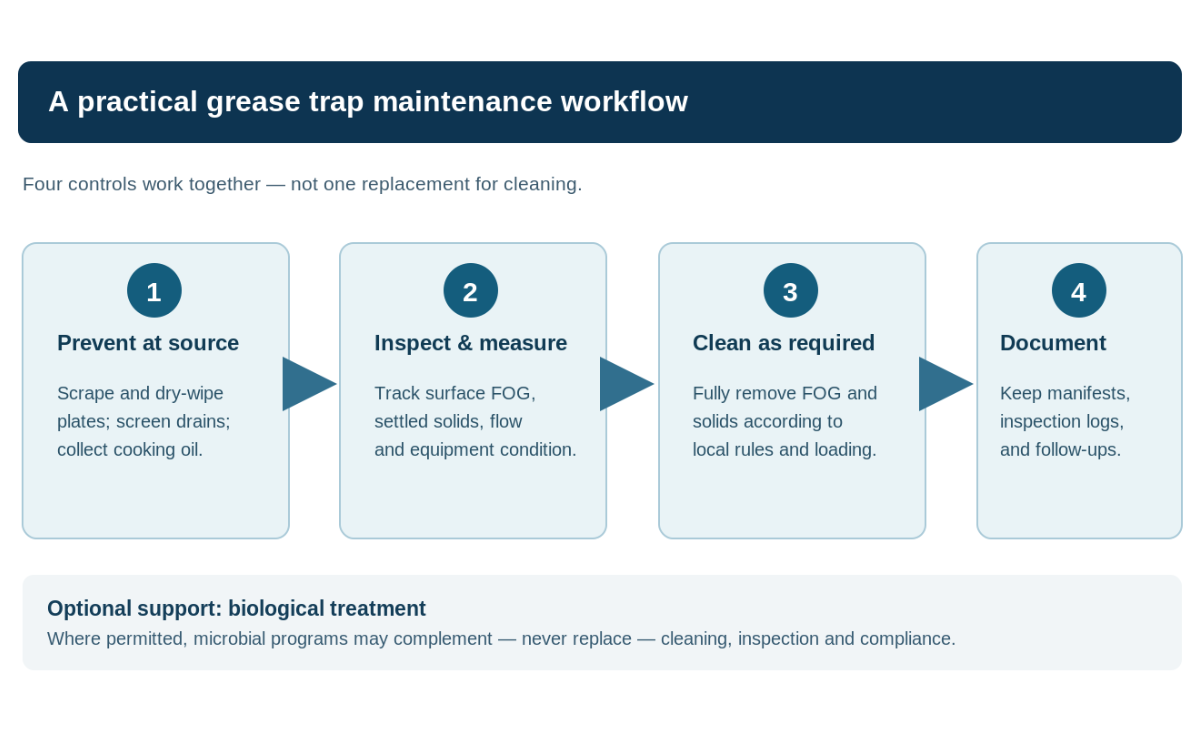
These practices align with the EPA's emphasis on managing FOG at its source, maintaining grease separation equipment, and protecting public sewers.
Warning Signs That a Grease Trap Needs Attention
Potential warning signs include:
- Slow-draining sinks or floor drains: Possible grease deposits, a plumbing restriction, or equipment malfunction.
- Recurring unpleasant odors: Possible decomposing residues, but also potentially defective seals or plumbing ventilation problems.
- Frequent drain blockages: A sign to inspect both upstream plumbing and downstream lines.
- Excessive grease or solids: Inspection measurements near or above the local cleanout threshold.
- Unusual liquid levels: Possible restricted flow, surcharge, or damage to internal components.
When these conditions appear, investigate the root cause rather than assuming another application of drain-cleaning chemical will solve the problem.
Can Biological Treatment Improve Grease Trap Performance?
Biological treatment introduces or supports microorganisms capable of metabolizing biodegradable organic compounds, including certain fats, oils, and grease. Microorganisms naturally produce enzymes such as lipases that break complex lipids into simpler compounds that may be further metabolized under suitable conditions.
Performance depends on microbial viability, contact with the waste, retention time, temperature, pH, wastewater chemistry, and local operating conditions.
For more on the underlying science, see How Bacteria Break Down Organic Waste in Wastewater Treatment Systems.
Biological Treatment vs. Chemical Grease Removal
Biological treatment and chemical grease removal work differently. Certain chemical products use surfactants or other agents to disperse or emulsify grease. That physical change does not necessarily eliminate the organic material, and dispersed grease may move farther downstream.
Biological treatment seeks to degrade suitable organic compounds through microbial activity. But the presence of bacteria alone does not guarantee successful treatment. How the microorganisms are delivered, where they establish contact, and whether they encounter suitable conditions all matter.
Why Some Biological Grease Trap Treatments Underperform
Conventional products may introduce free-floating microorganisms directly into wastewater. These microorganisms can be capable of FOG degradation, yet their actual effectiveness can be limited by operating conditions:
- Hydraulic washout: Suspended microorganisms may leave with the flow before establishing sufficient contact with accumulated grease.
- Limited contact with deposits: Bacteria in the water phase may not consistently reach surface grease layers and residue attached to pipe walls.
- Short retention time: Intermittent or high-volume kitchen flows can reduce opportunities for microbial growth and organic degradation.
- Unfavorable conditions: Temperature shifts, extreme pH, and disinfectants can inhibit microorganisms.
- Inconsistent application: Irregular dosing or poor distribution can further limit treatment performance.
These challenges do not mean conventional biological products never work. They illustrate why microbial delivery and contact with the targeted waste are important technology considerations.
How Drylet's Patented Micro Bioreactor Carrier Is Different
Drylet's patented Micro Bioreactor (MBR) technology is designed to improve the delivery of beneficial microorganisms to wastewater and organic deposits.
Rather than relying solely on bacteria dispersed in a liquid treatment, Drylet uses a dry, porous carrier loaded with concentrated beneficial microorganisms. The carrier serves as a physical delivery platform intended to position the microorganisms closer to the organic material they are designed to degrade.
1. Targeted microbial delivery
LiquifyGT's MBR particles are designed to associate with grease and organic residues, improving opportunities for microorganisms to contact material accumulating in drains and grease management systems.
2. A porous surface for microbial activity
The carrier's structure provides a physical surface for the microorganisms. This design supports a localized delivery approach instead of relying exclusively on free-floating cells in the wastewater.
3. Concentrated microbial placement
The dry formulation delivers beneficial microorganisms through carrier particles, providing an alternative to conventional liquid application methods.
4. Continued biological activity under suitable conditions
When conditions support growth and metabolism, microorganisms can reproduce and degrade accessible biodegradable organic compounds. The carrier is designed to support placement and contact, but it cannot eliminate all the effects of temperature, pH, disinfectants, limited oxygen, or short contact time.
Drylet products do not contain added enzymes. Their microorganisms naturally produce the enzymes involved in biological degradation.
The distinction is important: Drylet's differentiator is not simply that it contains bacteria, but how its patented carrier delivers them to the treatment environment. The patent supports the carrier-based design; site-specific performance still needs to be evaluated in real operating conditions.
What This Means for Restaurants and Commercial Kitchens
LiquifyGT biological grease trap and drain treatment applies Drylet's MBR platform to commercial kitchen FOG and organic waste management.
The product is designed to:
- Deliver beneficial microorganisms into grease- and residue-prone areas
- Support degradation of suitable biodegradable fats and organic material
- Help manage recurring odors associated with organic buildup
- Complement a routine drain and grease management program
- Help facilities evaluate ways to reduce avoidable reactive cleaning where performance supports it
Unlike chemical treatments intended primarily to disperse grease, LiquifyGT is designed to encourage biological degradation of organic material. Outcomes vary by site, and the product is not a substitute for required interceptor cleanouts.
Biological Treatment and Regulatory Compliance
Biological additives are regulated differently across jurisdictions. In its 2025 Best Management Practice and Standards Manual for Food Service Establishments, JEA, the public utility serving parts of Northeast Florida, distinguishes certain prohibited grease-emulsifying agents and enzyme additives from microbial additives.
JEA states that microorganisms are not prohibited under its program, while acknowledging that the effectiveness of added bacteria depends on favorable conditions. The utility also makes clear that using microorganisms does not exempt a food service establishment from mandatory pump-out requirements.
These are local requirements, not a nationwide approval of bacterial additives. Always confirm local rules before using any biological or chemical grease treatment.
For broader context, read What Is Bioaugmentation? How Beneficial Bacteria Improve Wastewater Treatment.
Field Example: LiquifyGT and Commercial Kitchen Drain Odors
A national upscale steakhouse chain experienced persistent odors from 16 kitchen drains despite regular chemical cleaning. During an eight-week LiquifyGT evaluation, the facility reported eliminated odors in all treated drains, an end to odor complaints, and improved drain flow.
This was a drain-odor application, not a controlled study proving that required grease interceptor pump-outs could be eliminated.
Read Drylet's Commercial Kitchen Drain Odor Case Study for the application and reported outcomes.
Looking to improve grease and odor management?
Explore LiquifyGT Biological FOG Treatment.
How to Build an Effective Commercial Grease Trap Maintenance Program
Identify Equipment and Compliance Requirements
Inventory each grease trap and interceptor, its size, location, manufacturer, and service obligations. Confirm local cleaning thresholds, minimum frequencies, reporting requirements, and additive rules.
Establish a Baseline
Review inspection reports, cleaning invoices, accumulation measurements, drain backups, and odor complaints to understand recurring problems and current maintenance costs.
Schedule Inspections and Cleaning
Use operating conditions and local requirements to plan routine inspection and complete cleaning. Arrange service before performance degrades or mandatory thresholds are exceeded.
Assign Responsibilities
Make kitchen procedures clear, train employees across shifts, and designate who reviews service documentation and follows up on problems.
Monitor Results
Useful indicators include grease and solids accumulation, drain backups, emergency service calls, odor complaints, repair frequency, maintenance expenses, and compliance findings. Use these to improve the program without relaxing required cleaning schedules.
Understanding Commercial Grease Trap Maintenance Costs
Total grease management expenses can include scheduled cleaning, hauling and disposal, equipment repairs, emergency drain service, employee time, and compliance administration. Costs vary with interceptor size, accessibility, waste volume, grease loading, local hauling rates, number of locations, and the frequency of unplanned interventions.
A facility seeking to control expenses should consider the entire maintenance program not just the price of one pump-out. Source control, timely inspections, and documented preventive measures may help reduce avoidable service calls without compromising compliance.
Frequently Asked Questions About Commercial Grease Trap Maintenance
How often should a restaurant grease trap be cleaned?
Cleaning frequency depends on equipment type, grease loading, manufacturer instructions, and local FOG requirements. Some jurisdictions prescribe minimum intervals and require earlier cleaning when accumulation reaches a specified threshold.
What happens if a grease trap is not cleaned?
Grease and solids can occupy separation capacity, increase grease carryover, create odors, restrict pipes, and contribute to backups, emergency service, and compliance problems.
What is the 25% grease trap rule?
It is a grease-and-solids accumulation threshold used by many authorities. The exact measurement method and mandatory cleaning schedule depend on the local ordinance; it is not a universal federal exemption from routine cleaning.
What is the difference between a grease trap and a grease interceptor?
Terminology varies. Hydromechanical devices are often smaller units near kitchen fixtures; gravity interceptors are commonly larger tanks with separation volume. Their design and maintenance requirements differ.
Does hot water remove grease from kitchen drains?
Hot water may liquefy some grease temporarily, but the material can separate or solidify farther downstream. Grease collection and source prevention are more reliable than flushing fats into plumbing.
How is Drylet's LiquifyGT different from a conventional bacterial liquid?
LiquifyGT uses a patented porous Micro Bioreactor carrier to deliver concentrated beneficial microorganisms into the treatment environment. Its design focuses on microbial placement and contact with organic waste, although actual performance depends on local operating conditions.
Conclusion: Effective FOG Management Starts with Consistent Maintenance
Commercial grease trap maintenance protects plumbing, supports reliable wastewater flow, helps prevent expensive disruptions, and supports compliance with local discharge requirements.
The strongest programs combine source control, equipment inspections, complete scheduled cleaning, employee training, and documented follow-through. Where permitted, biological treatment can provide a supplemental method for managing biodegradable organic buildup and associated odors.
Drylet's patented carrier-based technology adds another consideration when evaluating biological treatment: it is not only which microorganisms are applied, but how they are delivered to the waste.
Improve Your Commercial Kitchen FOG Management Program
Experiencing recurring drain odors, grease-related maintenance problems, or difficult organic buildup? Explore how Drylet's patented microbial delivery technology may fit your operation.
Talk with Drylet About LiquifyGT
Stay Ahead with S²: Systems & Solids
Get practical insights into FOG management, biological treatment, wastewater operations, and real-world results in Drylet's monthly industry digest.
Subscribe to S²: Systems & Solids
Interested in Distributing Biological FOG Solutions?
Drylet works with restaurant supply distributors, sanitation suppliers, wastewater service providers, and industry partners expanding their commercial treatment offerings.