Why FOG (Fats, Oils, and Grease) Disrupts Wastewater Treatment Systems

Why FOG (Fats, Oils, and Grease) Disrupts Wastewater Treatment Systems
FOG (fats, oils, and grease) is one of the most persistent operational challenges in wastewater treatment, yet it is often underestimated until performance begins to decline. Unlike soluble organic material, FOG behaves differently from the moment it enters a system. It cools, separates, and adheres to surfaces, gradually building into a problem that impacts hydraulics, biology, and equipment all at once.
For operators, the issue is rarely a single failure point. Instead, FOG creates a slow, system-wide degradation that reduces treatment efficiency, increases maintenance demands, and ultimately limits capacity.
Struggling with grease buildup or declining system performance?
Request a Free Consultation to identify where FOG is impacting your system and how to recover lost capacity.
How FOG Enters and Behaves in Wastewater Systems
FOG is introduced through a wide range of sources, including food processing operations, commercial kitchens, and industrial washdown processes. In municipal systems, it often originates from residential discharge and restaurant grease traps. In industrial environments—especially protein processing—FOG loading is continuous and significantly more concentrated.
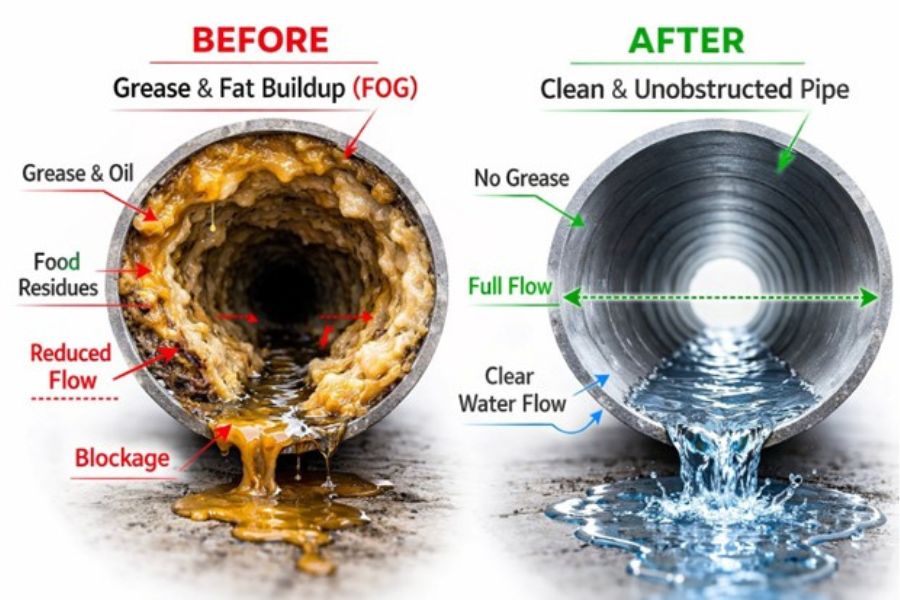
Once inside the system, FOG does not remain uniformly mixed. As temperatures drop and flow conditions change, fats and oils begin to separate from the water column. Lighter fractions rise, forming surface layers, while heavier compounds can attach to suspended solids or settle into sludge zones. At the same time, grease adheres to pipe walls, equipment surfaces, and structural components.
This combination of separation, flotation, and adhesion is what makes FOG uniquely disruptive. It does not pass through the system cleanly—it accumulates.
The Operational Impact of FOG on Treatment Performance
The effects of FOG are rarely immediate, which is why they are often misdiagnosed. Over time, however, the impact becomes increasingly visible across multiple parts of the system.
One of the earliest issues is a gradual loss of hydraulic capacity. As grease builds along pipe walls and within lift stations, it reduces the effective diameter of flow paths. This increases resistance, raises head pressure, and in severe cases leads to backups or overflow conditions. What begins as a minor buildup can evolve into a significant constraint on system throughput.
At the same time, FOG interferes with biological treatment. Microbial populations rely on access to organic material, but grease forms a physical barrier that limits contact between bacteria and the waste they are meant to break down. This results in reduced biological activity, lower BOD and COD removal efficiency, and slower system recovery after load fluctuations.
For a deeper look at how biological processes drive solids breakdown, see How Biological Sludge Reduction Works in Wastewater Lagoons.
Surface Accumulation and Fat Cap Formation

In lagoons, equalization basins, and other open systems, FOG tends to accumulate at the surface, forming visible mats or fat caps. These layers are more than just a cosmetic issue—they directly interfere with treatment performance.
In aerobic systems, surface accumulation limits oxygen transfer, reducing the efficiency of aeration and altering the balance of microbial populations. In anaerobic environments, trapped gases beneath a grease layer can disrupt digestion dynamics and reduce overall system stability.
As these layers thicken, they also reduce the effective treatment volume of the system. What appears to be a full lagoon may, in reality, have significantly less active capacity due to surface and subsurface accumulation.
Equipment Fouling and Maintenance Burden
FOG does not stay confined to one area. It travels through the system and adheres to mechanical components, creating ongoing maintenance challenges. Pumps, diffusers, skimmers, and sensors are particularly vulnerable.
Over time, this buildup reduces equipment efficiency and increases the frequency of cleaning and repair. Diffusers may lose effectiveness, pumps can become partially obstructed, and sensors may provide inaccurate readings due to coating. These issues compound, leading to inconsistent performance and higher operating costs.
Industrial vs Municipal FOG Challenges
While FOG is a concern in all wastewater systems, the severity and impact vary significantly between municipal and industrial operations.
Municipal systems typically deal with intermittent FOG loading, often tied to residential discharge and restaurant activity. The primary issues tend to occur in collection systems, where grease accumulates over time and contributes to blockages or sewer overflows.
Industrial systems, on the other hand, face continuous and high-strength FOG loading. Facilities such as protein processors, rendering plants, and food manufacturers generate large volumes of fats and oils as part of daily operations. This creates a much higher risk of accumulation within treatment systems, particularly in DAF units, basins, and lagoons.
This is one of the reasons industrial facilities often experience faster solids buildup and more aggressive performance decline. For additional context, see Industrial Wastewater Sludge Problems: Why Solids Build Up Faster Than Expected.
Where FOG Causes the Most Damage
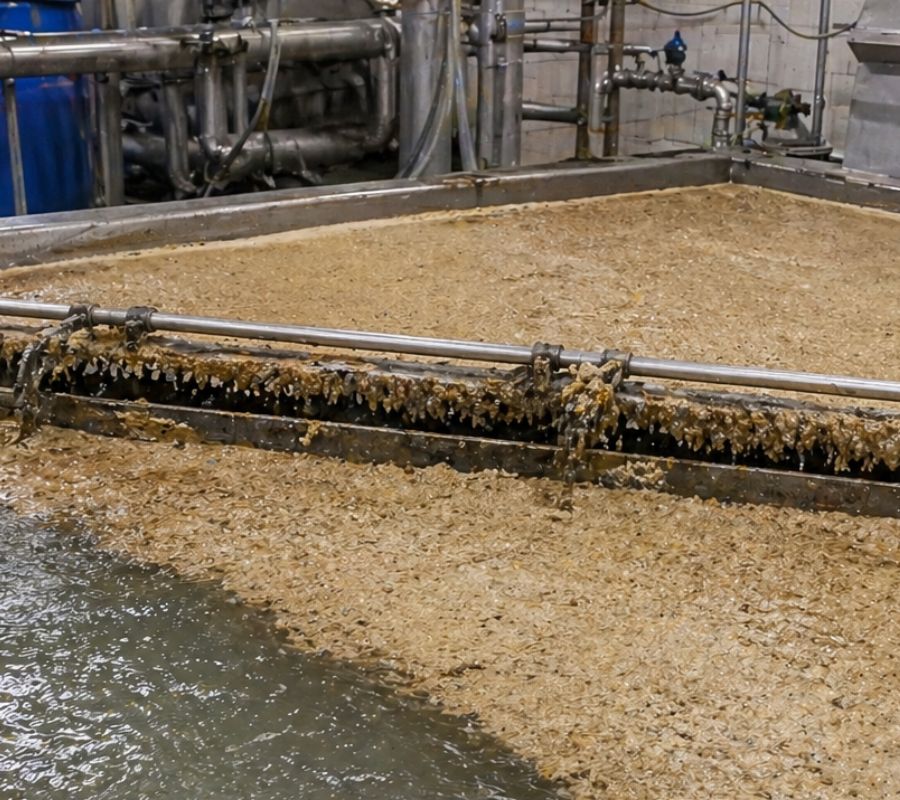
FOG impacts multiple stages of wastewater treatment, often simultaneously. In collection systems, it contributes to pipe restriction and flow issues. In DAF systems, excessive grease loading can reduce separation efficiency and increase carryover. In aeration basins, it interferes with oxygen transfer and microbial activity. In lagoons, it leads to surface mats, sludge accumulation, and reduced treatment capacity.
Because these impacts are interconnected, addressing FOG in only one part of the system rarely resolves the problem entirely.
If your system is showing signs of reduced performance, it may not be a single issue. Signs Your Wastewater Lagoon Is Losing Treatment Capacity provides additional insight into how these problems develop.
Why Traditional FOG Management Approaches Fall Short
Most facilities rely on a combination of grease traps, skimming, chemical treatments, and mechanical removal to manage FOG. While these methods can provide short-term relief, they are primarily reactive.
They remove or relocate accumulated grease but do not prevent it from forming in the first place. As a result, the cycle continues—FOG enters the system, accumulates, and must be removed again.
Over time, this leads to increasing maintenance frequency, higher operational costs, and ongoing performance limitations.
Shifting from Removal to Prevention

Long-term control of FOG requires a shift in approach. Instead of focusing solely on removing grease after it accumulates, more effective strategies target the breakdown of FOG within the system.
Biological treatment plays a key role in this shift. By accelerating the degradation of fats, oils, and grease, it reduces the likelihood of accumulation, supports consistent system performance, and helps restore lost capacity.
For facilities managing lagoons or large treatment systems, this approach can significantly reduce the need for disruptive maintenance activities such as dredging. To explore this further, see Alternatives to Lagoon Dredging.
Reduce FOG Before It Becomes a System Constraint
FOG-related issues rarely resolve on their own. Left unaddressed, they continue to impact capacity, efficiency, and operational costs.

Frequently Asked Questions
Why is FOG a problem in wastewater treatment?
FOG separates from water, accumulates on surfaces, and interferes with both hydraulic flow and biological treatment processes, leading to reduced efficiency and increased maintenance.
How does grease affect wastewater treatment plants?
Grease coats equipment and limits microbial access to organic material, reducing treatment performance and increasing operational challenges.
What causes FOG buildup in wastewater systems?
FOG buildup occurs when fats, oils, and grease cool and separate from wastewater, allowing them to adhere to surfaces and accumulate over time.
How do you remove fats, oils, and grease from wastewater?
FOG can be removed mechanically through skimming and separation, but long-term control requires biological treatment to break down grease before it accumulates.