Duckweed in Wastewater Treatment: Causes, Problems, and How to Control It

Duckweed in wastewater treatment lagoons is a fast-growing floating plant that thrives in nutrient-rich, low-mixing conditions. While small in size, it can create serious operational issues by blocking oxygen transfer, reducing sunlight penetration, and accelerating sludge accumulation. Effective control requires addressing root causes such as excess nutrients, poor aeration, and low biological activity—not just surface removal.
Duckweed is not just a surface issue—it’s often an indicator of excess nutrients, poor mixing, and incomplete biological treatment within the lagoon.
If you’ve noticed a green layer forming across the surface of your lagoon, you’re not dealing with a cosmetic issue—you’re looking at a system imbalance.
Duckweed has become a more common challenge across municipal and industrial wastewater lagoons, and it tends to show up quickly. What starts as scattered patches can turn into full surface coverage in a matter of weeks, especially during warmer months. Once established, it becomes difficult to control and even harder to eliminate permanently.
But here’s the key point most operators miss: duckweed is not the root problem.
It’s a symptom of underlying treatment conditions—and if those conditions aren’t addressed, the lagoon will continue to lose efficiency regardless of how often the surface is cleared. In many cases, these same conditions are tied to sludge accumulation and declining treatment efficiency. If you’re seeing duckweed, it’s worth understanding what causes sludge buildup in wastewater lagoons and how it impacts system performance.

What Is Duckweed and Why Does It Grow in Wastewater Lagoons?
Duckweed is a small floating aquatic plant that thrives in environments where nutrients are abundant and water movement is limited. Wastewater lagoons—especially those with elevated organic loading—create an ideal environment for rapid growth. In a properly balanced lagoon, nutrients are continuously consumed by active microbial populations. However, when biological activity is insufficient or uneven, nutrients remain available in the water column. This creates the perfect conditions for duckweed to establish and spread.
Calm surface conditions play an equally important role. Lagoons with poor mixing or dead zones allow duckweed to accumulate and form dense mats. Without disruption, those mats expand quickly, covering large portions of the lagoon surface.
Why Duckweed Is a Problem in Wastewater Treatment
Oxygen Transfer Impact
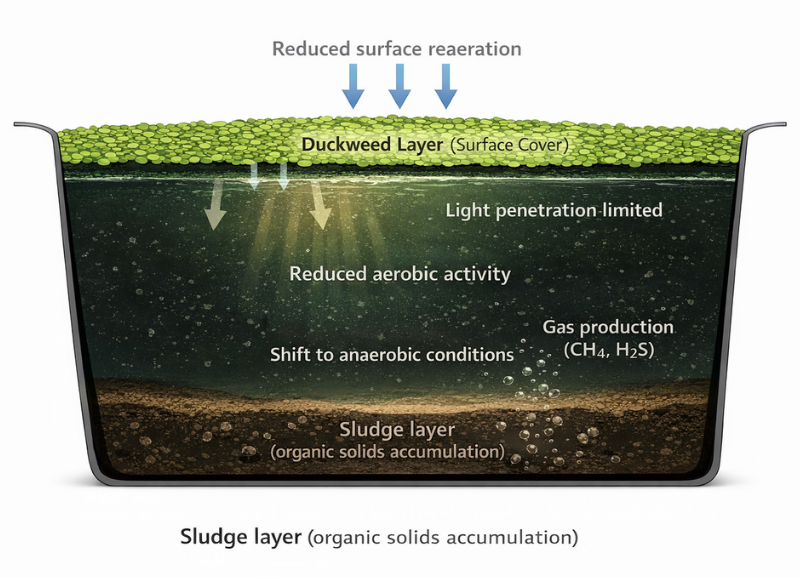
Lagoons rely heavily on natural diffusion and surface interaction to introduce oxygen into the system. When duckweed forms a dense layer, it acts as a barrier between the air and the water, significantly reducing this transfer.
Aeration Disruption
In aerated lagoons, duckweed interferes with surface mixing patterns, limiting how effectively oxygen is distributed throughout the basin.
Light Limitation
Sunlight supports algae, which produce oxygen during daylight hours. When duckweed blocks light, natural oxygen production drops.
Sludge Contribution
As duckweed dies and settles, it adds organic material to the lagoon bottom, contributing to long-term solids accumulation.
Learn how this process impacts long-term performance in Signs Your Wastewater Lagoon is Losing Capacity.
What Causes Duckweed Growth in Wastewater Lagoons?
.png)
Duckweed growth is driven by a combination of environmental and operational factors, and it rarely occurs in isolation. The primary driver is excess nutrient availability. Elevated levels of nitrogen, phosphorus, and organic material provide the fuel needed for rapid plant growth. These conditions are common in lagoons that are overloaded or not effectively digesting incoming waste.
Equally important is poor mixing. When lagoons develop stagnant zones, duckweed is able to collect and expand without disruption. These areas often go unnoticed until surface coverage becomes significant.
A less obvious but critical factor is an imbalance between organic loading and biological treatment capacity. When microbial populations are not keeping pace with incoming waste, nutrients remain available in the water column—creating ideal conditions for duckweed growth.
Seasonal temperature increases can accelerate all of these conditions. As water warms, biological processes speed up—but so does plant growth. If the system is already imbalanced, duckweed can quickly take over.
For more on seasonal impacts, see How Cold Weather Impacts Wastewater Lagoon Performance
How to Get Rid of Duckweed in Wastewater Lagoons
Most operators initially approach duckweed as a surface problem, which leads to short-term solutions that don’t hold. Mechanical removal is often the first step. Skimming or harvesting duckweed can provide immediate visual improvement, but it does nothing to stop regrowth. In many cases, the plant returns within weeks because the underlying conditions remain unchanged.
Chemical treatment is another option, but it comes with trade-offs. Chemical treatments can provide short-term control, but dead plant material remains in the system and contributes to organic loading as it decomposes. In regulated systems, chemical use may also be limited depending on discharge requirements.
Improving aeration and mixing can help reduce surface accumulation, particularly in systems where dead zones are contributing to the issue. However, this alone may not be enough if nutrient levels remain elevated.
Long-term control requires a different approach—one that focuses on restoring biological balance within the lagoon.
When microbial activity is optimized, nutrients are consumed more efficiently, leaving less available for plant growth. At the same time, organic solids are broken down more effectively, reducing sludge accumulation and improving overall treatment performance.
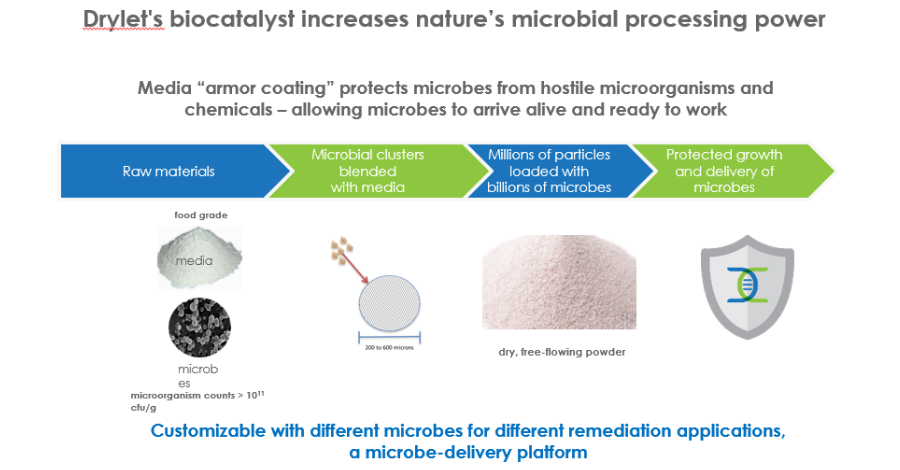
Learn how this works in detail: How Biological Sludge Reduction Works in Wastewater Lagoons
Duckweed vs. Algae: Understanding the Difference
Duckweed and algae are often confused, but they behave very differently in wastewater systems. Duckweed is a floating plant that forms a physical layer across the surface. Its impact is primarily mechanical—it blocks oxygen transfer and light penetration.
Algae, on the other hand, are microorganisms that exist within the water column. While excessive algae can create its own challenges, it also contributes oxygen during daylight hours through photosynthesis. Understanding the difference matters, because the control strategies are not the same. Treating duckweed like algae often leads to ineffective results.
The Real Issue: Duckweed Is a Symptom, Not the Root Cause
The presence of duckweed is a signal that something in the lagoon is out of balance.
It typically indicates:
- Excess nutrients are not being consumed
- Biological digestion is incomplete
- Mixing or oxygen distribution is inconsistent
Removing duckweed without addressing these factors is like skimming foam off a boiling pot—it may look better temporarily, but the process causing it hasn’t changed. When the underlying biology is corrected, duckweed loses its advantage and naturally declines.
Not sure what’s driving duckweed growth in your lagoon?
Every lagoon behaves differently depending on loading, sludge levels, and system design.
Request a Technical Assessment from a Drylet Specialist
How to Prevent Duckweed from Returning
Long-term prevention comes down to maintaining stable operating conditions. Lagoons that consistently perform well tend to have active biological populations, balanced nutrient levels, and sufficient mixing to prevent stagnation. When these elements are in place, duckweed struggles to establish itself.
Monitoring sludge levels is also critical. As sludge accumulates, it reduces effective treatment volume and contributes to nutrient release, both of which support plant growth.
Learn how to track this in How to Measure Sludge Depth in Wastewater Lagoons
FAQ
Is duckweed harmful in wastewater lagoons?
Yes. It reduces oxygen transfer, limits sunlight penetration, and contributes to sludge buildup, all of which reduce treatment efficiency.
What causes duckweed in wastewater treatment systems?
Duckweed is caused by excess nutrients, poor mixing, and insufficient biological activity within the lagoon.
How do you permanently get rid of duckweed?
Permanent control requires addressing the root causes—improving biological treatment, reducing nutrient availability, and maintaining proper mixing.
Does aeration eliminate duckweed?
Aeration can help reduce accumulation, but it does not fully solve the problem unless nutrient and biological conditions are also addressed.
Still dealing with duckweed in your lagoon?
Duckweed is often a warning sign—not just a surface issue.
If your lagoon is experiencing:
- Surface coverage
- Sludge buildup
- Reduced treatment efficiency
…it’s time to look deeper.
Stay Ahead of Wastewater Challenges
Operators across municipal and industrial systems are dealing with evolving challenges—from sludge buildup to nutrient imbalance and lagoon performance issues.
Our monthly newsletter shares:
- Real-world case studies
- Practical operator insights
- Proven strategies to improve treatment performance
Sign up for Systems and Solids: Drylet's Monthly Newsletter