58% Total Solids Reduction in an 8-Million-Gallon Anaerobic Lagoon at an Industrial Rendering Facility

Executive Summary
Sludge accumulation is one of the most significant operational challenges facing industrial wastewater lagoons. As solids build up over time, available treatment volume decreases, hydraulic retention time is reduced, and biological treatment efficiency declines. These changes often result in higher operating costs, increased odor potential, and additional loading on downstream treatment processes.
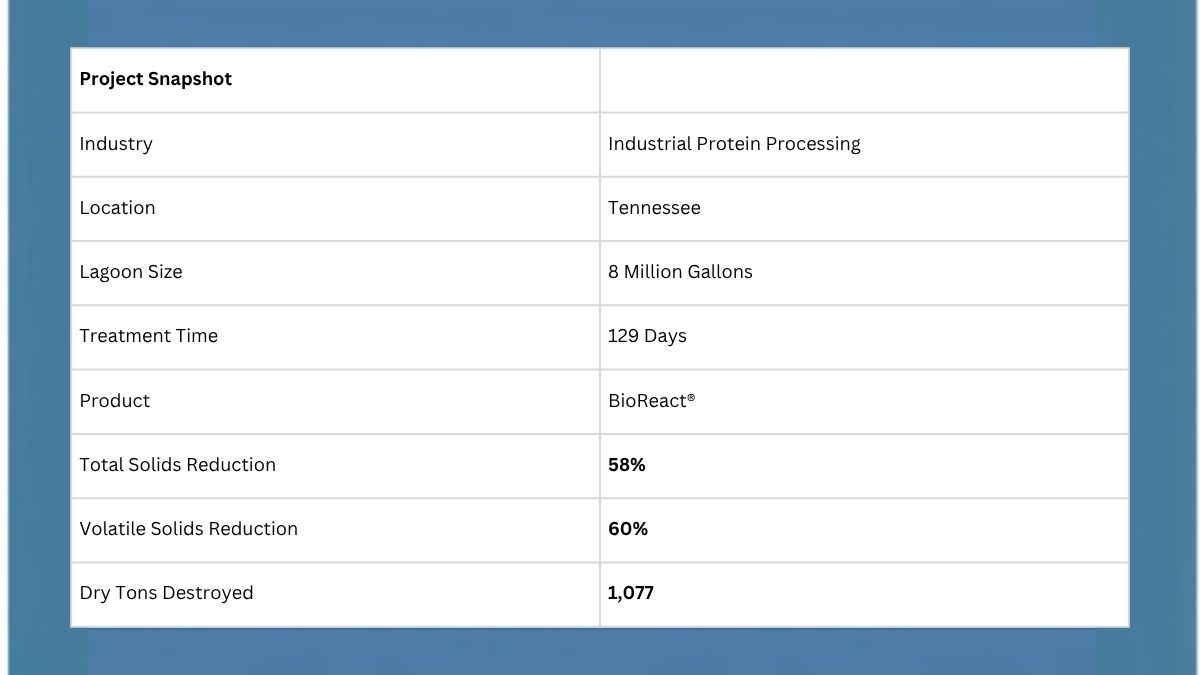
This case study highlights how an industrial protein processing facility in Tennessee restored anaerobic lagoon performance using Drylet BioDredger® biological treatment. Over a 129-day evaluation period, the facility achieved a 58% Total Solids Reduction (TSR) and 60% Volatile Solids Reduction (VSR) while improving overall lagoon treatment performance.
Beyond reducing accumulated solids, the project biologically destroyed more than 1,077 dry tons of solids—an outcome that exceeded the original treatment target by 86%. Laboratory analyses also demonstrated lower BOD, COD, and CBOD concentrations entering the secondary lagoon, indicating improved treatment efficiency throughout the wastewater system.
Facility Overview
Industry: Industrial Protein Processing Facility
Location: Tennessee
Treatment System: 8-Million-Gallon Anaerobic Lagoon
Treatment Product: Drylet BioDredger®
Treatment Period: 129 Days
Key Results
- 58% Total Solids Reduction (TSR)
- 60% Volatile Solids Reduction (VSR)
- 1,077 Dry Tons of Solids Biologically Reduced
- 86% Greater Solids Reduction Than the Original Project Target
- Improved BOD, COD, and CBOD Reduction
- Enhanced Overall Lagoon Treatment Performance
The Challenge
Large anaerobic lagoons are designed to biologically stabilize high-strength industrial wastewater while storing and reducing accumulated organic solids. Over time, however, solids accumulate faster than they can naturally degrade, particularly in high-loading industries such as protein processing.
As sludge accumulates, facilities often experience:
- Reduced treatment capacity
- Shorter hydraulic retention times
- Increased organic loading to downstream treatment processes
- Greater odor potential
- Higher sludge management and hauling costs
- Increased risk of future dredging projects
For this Tennessee protein processing facility, solids accumulation within an 8-million-gallon anaerobic lagoon had become a growing operational concern. Rather than relying on costly mechanical dredging, the facility evaluated a biological treatment approach designed to accelerate the natural breakdown of accumulated organic solids while allowing normal operations to continue.
Treatment Approach
Drylet developed a biological treatment program using BioDredger® to stimulate microbial activity and accelerate the biological degradation of accumulated lagoon solids.
On April 6, 2021, approximately 3,300 pounds of BioDredger® were applied to the anaerobic lagoon. An industrial mixing system was used during product application to improve distribution throughout the treatment area. The same mixing process was utilized during both the initial and final sampling events to help ensure representative samples were collected.
Baseline laboratory samples were collected immediately before treatment began. A second round of sampling was performed on August 12, 2021, providing a 129-day evaluation period for measuring treatment performance.
The primary objective of the project was to biologically reduce accumulated solids while improving overall wastewater treatment performance and reducing the organic loading entering downstream treatment processes.
Treatment Results
Laboratory analysis demonstrated substantial biological degradation of accumulated lagoon solids during the treatment period.
The project achieved:
- 58% Total Solids Reduction (TSR)
- 60% Volatile Solids Reduction (VSR)
Perhaps even more significant, the treatment biologically destroyed an estimated 1,077 dry tons of accumulated solids, exceeding the original project target by 86%.

The treatment also improved overall lagoon performance. Effluent monitoring showed measurable reductions in Biochemical Oxygen Demand (BOD), Chemical Oxygen Demand (COD), and Carbonaceous Biochemical Oxygen Demand (CBOD) leaving the anaerobic lagoon and entering the secondary treatment pond. Lower organic loading entering downstream processes can improve treatment efficiency, reduce biological stress, and support more consistent wastewater treatment performance.
These results demonstrate that biological solids reduction can provide benefits beyond simple sludge reduction by improving the overall effectiveness of an industrial lagoon system.
Why Biological Dredging Improved Lagoon Performance
Removing accumulated solids is only one measure of lagoon performance. The greater operational benefit comes from restoring the biological treatment capacity of the wastewater system.
As sludge accumulates within an anaerobic lagoon, effective treatment volume decreases and hydraulic retention time is reduced. Less contact time between wastewater and beneficial microorganisms limits the biological degradation of organic material, increasing the organic load passed to downstream treatment processes.
In this project, the biological reduction of accumulated solids not only restored lagoon capacity but also improved overall treatment performance. Laboratory analysis and plant monitoring demonstrated lower Biochemical Oxygen Demand (BOD), Chemical Oxygen Demand (COD), and Carbonaceous Biochemical Oxygen Demand (CBOD) concentrations leaving the anaerobic lagoon and entering the secondary treatment pond. These reductions indicate that more organic material was being biologically degraded within the primary lagoon before reaching downstream treatment units.
As a result, the facility experienced several operational benefits:
- Increased effective lagoon treatment capacity
- Longer hydraulic retention times
- Reduced organic loading on downstream ponds
- Improved biological stability
- Lower sludge management requirements
- Reduced long-term maintenance costs
Rather than simply removing accumulated solids, the project enhanced the overall performance of the wastewater treatment system by restoring biological activity where it was needed most.
Why Biological Dredging Instead of Mechanical Dredging?
Mechanical dredging has traditionally been used to remove accumulated sludge from industrial lagoons. While effective at physically removing solids, dredging often requires specialized equipment, dewatering operations, transportation, landfill disposal, and varying levels of operational disruption.
Biological dredging offers a different approach.
Instead of excavating accumulated sludge, Drylet BioDredger® stimulates naturally occurring microorganisms that accelerate the biological breakdown of organic solids already present within the lagoon. This process reduces sludge accumulation while allowing the wastewater treatment system to remain in operation.
Compared to conventional dredging, biological treatment can provide several advantages:
- Reduces accumulated organic sludge through biological activity
- Minimizes operational disruption during treatment
- Eliminates the need for large-scale excavation equipment
- Reduces sludge hauling and disposal requirements
- Improves biological treatment performance while solids are being reduced
- Supports long-term lagoon capacity restoration
Every wastewater system is unique, and the appropriate solids management strategy depends on lagoon conditions, sludge composition, treatment objectives, and facility operations. This project demonstrates how biological treatment can successfully reduce accumulated solids while improving overall lagoon performance.
Download the Complete Technical Case Study
Want to review the complete laboratory analysis and engineering data behind these results?
Download the full technical case study to explore the treatment methodology, sampling procedures, solids calculations, laboratory analyses, and operational performance data from this 129-day biological dredging project at an industrial protein processing facility.
The report includes:
- Complete laboratory sampling results
- Total Solids (TS) and Volatile Solids (VS) analysis
- BOD, COD, and CBOD performance data
- Biological treatment methodology
- Solids reduction calculations
- Engineering conclusions and technical findings

Key Takeaways
This project demonstrates how biological treatment can successfully reduce accumulated solids while improving overall wastewater treatment performance in large industrial anaerobic lagoons.
During the 129-day evaluation period, Drylet BioDredger® delivered measurable improvements in both solids reduction and biological treatment efficiency.
Project Highlights
- 58% Total Solids Reduction (TSR)
- 60% Volatile Solids Reduction (VSR)
- 1,077 dry tons of solids biologically reduced
- 86% greater solids reduction than the original project target
- Reduced BOD, COD, and CBOD loading
- Improved anaerobic lagoon treatment performance
- Minimal disruption to ongoing plant operations
For industrial wastewater facilities managing sludge accumulation, biological dredging may provide an effective alternative to traditional mechanical dredging by restoring treatment capacity while reducing long-term sludge management costs.
Conclusion
This case study demonstrates how biological treatment can provide measurable reductions in accumulated lagoon solids while improving overall wastewater treatment performance. During a 129-day treatment period, an industrial protein processing facility achieved a 58% Total Solids Reduction, 60% Volatile Solids Reduction, and biologically reduced more than 1,077 dry tons of accumulated solids. These results highlight the potential for biological dredging to restore lagoon capacity, improve treatment efficiency, and reduce long-term sludge management costs for industrial wastewater facilities.
Frequently Asked Questions
What is biological dredging?
Biological dredging is a process that uses naturally occurring microorganisms and biological catalysts to accelerate the breakdown of accumulated organic sludge within wastewater lagoons. Unlike mechanical dredging, biological dredging reduces organic solids through biological activity while allowing the treatment system to remain in operation.
How long did this lagoon treatment take?
This project was evaluated over 129 days, beginning with the BioDredger® application on April 6, 2021, and concluding with post-treatment sampling on August 12, 2021. During that time, the facility achieved a 58% Total Solids Reduction and 60% Volatile Solids Reduction.
What is the difference between Total Solids and Volatile Solids?
Total Solids (TS) represent the total amount of solid material present in wastewater, including both organic and inorganic material. Volatile Solids (VS) represent the organic portion of those solids that microorganisms can biologically degrade. Measuring both values provides a more complete picture of lagoon performance and biological treatment effectiveness.
Can biological dredging replace mechanical dredging?
Every wastewater lagoon is different, and the most appropriate sludge management strategy depends on lagoon conditions, sludge depth, solids composition, and operational goals. In many facilities, biological dredging can significantly reduce accumulated organic solids, restore treatment capacity, and delay or reduce the need for mechanical dredging.
What industries benefit from biological dredging?
Biological dredging is commonly used in industries with high organic wastewater loading, including:
- Protein processing
- Food and beverage manufacturing
- Meat and poultry processing
- Dairy processing
- Rendering facilities
- Municipal wastewater treatment
- Agricultural wastewater systems
How can I determine if biological dredging is right for my facility?
The first step is understanding your lagoon's current condition, including sludge accumulation, treatment performance, hydraulic retention time, and operational objectives. A technical evaluation can help determine whether biological treatment is an appropriate solution for your wastewater system.
Ready to Improve Wastewater Treatment Performance?
Every wastewater treatment system is unique. If your facility is experiencing sludge accumulation, reduced lagoon capacity, odors, high sludge hauling costs, or inconsistent biological performance, Drylet can help evaluate practical biological treatment solutions.
Request a Free Technical Assessment
Interested in Becoming a Drylet Distributor?
Drylet is expanding its distributor network across municipal, industrial, food processing, agricultural, and grease management markets. If you're interested in offering innovative biological wastewater treatment solutions, we'd love to hear from you.
Related Wastewater Resources
Continue exploring wastewater treatment optimization, sludge management, and biological treatment with these related technical resources: