
ManureMagic® Reduces Lagoon Sludge by 42% at a Grow-to-Finish Swine Operation

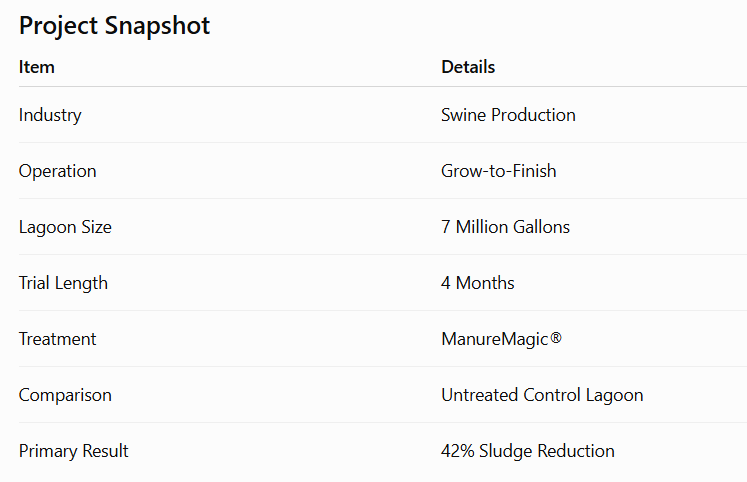
A commercial grow-to-finish swine operation compared ManureMagic® against an untreated control lagoon over four months. The treated lagoon achieved a 42% reduction in sludge depth, eliminated pit jetting, improved manure flowability, and reduced crust formation, while the untreated lagoon showed no measurable change.
Results at a Glance
- 42% reduction in lagoon sludge levels in 4 months
- Pit jetting eliminated
- Improved manure flowability
- Reduced solids mounding and crust formation
- No change observed in the untreated control lagoon
Key Results
- 42% average reduction in lagoon sludge
- Eliminated pit jetting
- Improved manure flowability
- Reduced solids mounding and surface crusts
- No measurable change in the untreated control lagoon
- Results achieved in four months
Facility Overview
A large grow-to-finish swine operation using pull-plug manure pits was experiencing increasing labor and maintenance challenges associated with solids accumulation. Over time, manure pits became more difficult to clean, and solids buildup in the manure lagoon continued to increase. These conditions required more labor and created operational inefficiencies for farm staff.
Key issues included:
- Time-consuming pit cleaning
- Solids buildup in manure pits
- Increasing sludge accumulation in the lagoon
- Reduced manure flowability
- Formation of solids mounds and crust layers
The facility manager was interested in reducing solids accumulation but remained skeptical of biological treatment products. He agreed to conduct a trial only if the results could be compared against a similar untreated lagoon.
Trial Design
The manager selected two of the worst performing lagoons for the evaluation.
Both lagoons operated under nearly identical conditions:
- Lagoon size: 7 million gallons
- Barns served: Four 1,000-head barns per lagoon
- Manure management system: Pull-plug pits
- Plug schedule: Each barn pulled once per week in a rotating schedule
- Initial sludge levels: Similar levels of accumulated sludge
One lagoon was treated with ManureMagic® biological treatment for manure lagoons, while the other lagoon served as a control lagoon with no treatment.
Treatment Program
In May, the treatment program began.
- 125 pounds of ManureMagic® were applied directly to the lagoon.
- An additional 50 pounds were applied to the barns’ pull-plug pits over the course of four months.
Treating both the lagoon and the pits was intended to improve solids breakdown throughout the manure management system.
Operational Changes Observed
Within two weeks, farm staff began noticing improvements during pit cleaning.
Operators reported several operational benefits:
- Manure became more uniform and easier to move
- Cleaning time decreased
- Pit jetting was no longer necessary
- Less buildup of solids piles inside the pits
These changes improved manure flow and reduced the labor required to maintain the system.
Lagoon Sludge Measurements
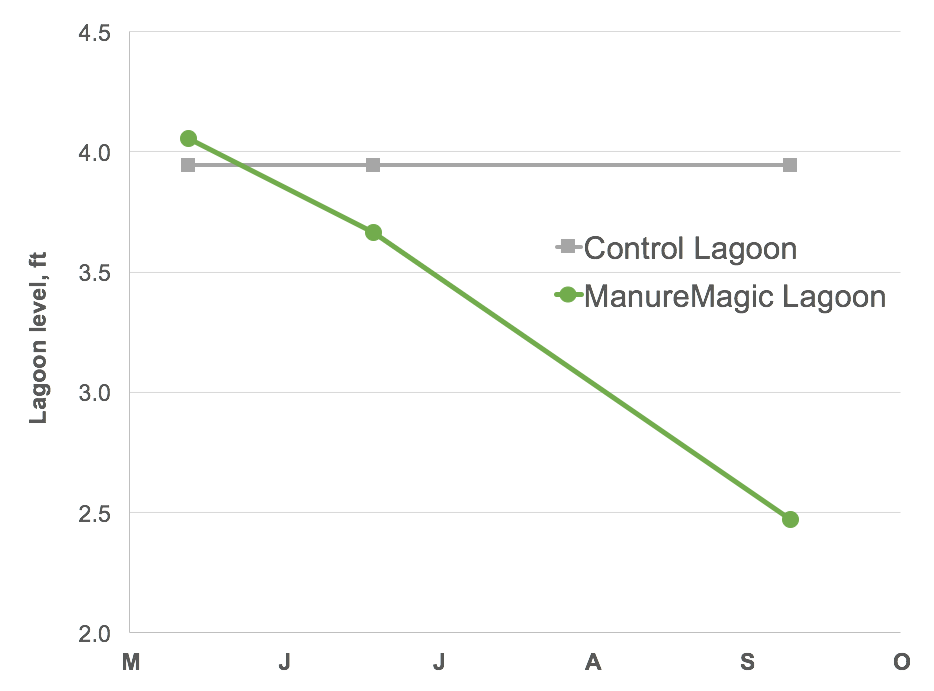
To track changes in sludge levels, measurements were taken at nine fixed locations within each lagoon. Understanding how to measure sludge depth in wastewater lagoons is an important step in evaluating lagoon performance and long-term solids accumulation.
Measurements were taken in:
- June (1 month after treatment)
- September (4 months after treatment)
After One Month
The treated lagoon showed approximately 10% sludge reduction, with sludge depth decreasing between 6 -12 inches depending on measurement location.
After Four Months
By the end of the trial:
- Average sludge reduction: 42%
- Individual reductions: 18–30 inches
In contrast, the untreated control lagoon showed no measurable change during the same period.
Additional Benefits Observed
Beyond sludge reduction, operators also reported improvements in lagoon and manure characteristics:
- Reduced hydrogen sulfide (H₂S) odors
- Improved manure flowability
- Less surface crust formation
- More consistent manure handling
Operational Impact
For this facility, the improvements translated into several operational advantages:
- Reduced labor associated with pit cleaning
- Elimination of pit jetting
- Slower sludge accumulation in the lagoon
- Improved manure handling consistency
Extending lagoon life and reducing solids buildup can help delay or eliminate the need for costly lagoon cleanouts or expansion projects.
Operator Response
After reviewing the results of the trial, the farm management team was impressed with the improvements observed in both the pits and the lagoon. Based on the results, the company began planning expanded use of ManureMagic® across additional operations.
Why This Matters for Swine Producers
Manure solids accumulation is one of the most persistent operational challenges in swine production systems.
Over time, sludge buildup can:
- Reduce lagoon storage capacity
- Increase odor emissions
- Complicate manure handling
- Accelerate the need for lagoon dredging
Biological treatment approaches that enhance microbial breakdown of manure solids can significantly reduce these operational pressures while improving lagoon performance.
Evaluate Sludge Conditions in Your Manure Lagoon
Every swine and dairy operation manages manure differently depending on herd size, feed programs, lagoon design, and manure handling practices. Over time, solids accumulate in manure pits and lagoons. As sludge builds up, lagoon storage capacity can gradually decline, manure handling becomes more difficult, and odor issues may increase. Understanding the condition of your lagoon is the first step in improving manure management.
A technical evaluation can help determine:
- Current sludge accumulation levels
- Remaining lagoon storage capacity
- Opportunities to reduce solids buildup
- Strategies to improve manure flow and lagoon performance
Request a technical review of your manure lagoon system.
Stay Informed on Wastewater and Manure Management
Many livestock operations face similar challenges related to lagoon sludge accumulation, manure handling, and odor control. Our newsletter shares practical insights, case studies, and management strategies focused on improving lagoon performance and reducing solids buildup.
→ Subscribe to the Wastewater Performance Newsletter
FAQ
How much sludge did ManureMagic® remove?
The treated lagoon achieved an average 42% reduction in sludge depth after four months, while an untreated control lagoon showed no measurable reduction.
Why was a control lagoon included?
Using an untreated lagoon operating under nearly identical conditions allowed the facility to directly compare results and verify that the observed sludge reduction was due to the biological treatment rather than seasonal or operational changes.
How quickly were improvements observed?
Operators noticed easier manure handling and improved pit cleaning within two weeks. Sludge measurements showed approximately 10% reduction after one month and 42% reduction after four months.