
Swine Pit Solids Reduction Case Study: ManureMagic® Reduced Jetting Events by 68%

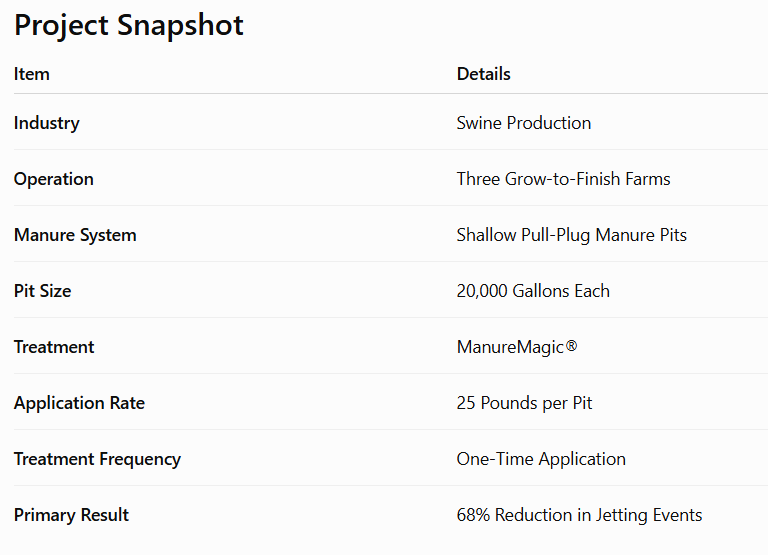
A major commercial swine producer evaluated whether biological treatment could reduce persistent solids accumulation in shallow manure pits and decrease reliance on costly mechanical jetting. Following a single application of ManureMagic®, jetting service calls declined by 68% over the following year, while operators reported improved manure flow and fewer maintenance disruptions.
Key Results
- 68% reduction in jetting service calls year-over-year
- Three commercial swine farms treated
- One-time application of ManureMagic®
- Improved manure flowability
- Reduced stubborn solids buildup
- Lower dependence on mechanical jetting
- Measurable results sustained throughout the year
Project Snapshot
The Challenge
Managing solids accumulation in shallow swine manure pits can become an ongoing labor and maintenance challenge. As manure thickens and solids accumulate, flow restrictions develop that often require frequent mechanical jetting to restore normal manure movement. A major swine producer was experiencing persistent buildup that resulted in repeated jetting service calls, increasing labor requirements, maintenance costs, and operational disruptions across multiple farms. Rather than continuing to rely solely on mechanical intervention, the producer wanted to determine whether biological treatment could reduce solids accumulation and improve manure movement throughout the system.
Trial Design
The evaluation included three commercial grow-to-finish swine farms. Each farm utilized two 20,000-gallon shallow manure pits operating under similar production conditions. In early 2019, each manure pit received a single application of 25 pounds of ManureMagic®. Performance was evaluated by comparing annual jetting service records before and after treatment.
Prior to treatment, the producer recorded 163 jetting service calls during 2018 to break up stubborn manure accumulation and restore flow. Following treatment, only 52 jetting events were required during 2019.
The Biological Solution
Instead of repeatedly treating the symptoms through mechanical jetting, ManureMagic® was applied to enhance the natural biological breakdown of accumulated manure solids. By increasing the activity of beneficial microorganisms, the treatment accelerated the breakdown of organic solids that restricted manure flow. As solids became more liquefied, manure moved more freely through the shallow pits, reducing the need for mechanical intervention. This biological approach follows the same principles discussed in our article on bioaugmentation, where beneficial microorganisms enhance existing microbial populations to improve the breakdown of organic material naturally.
Results
The improvements continued throughout the year following the one-time application. Compared to the previous year, jetting service calls fell from 163 to just 52, representing a 68% reduction in maintenance interventions.
Farm personnel also reported several operational improvements:
- Improved manure flow through shallow pits
- Reduced stubborn solids accumulation
- Fewer maintenance interruptions
- Lower labor requirements
- Reduced dependence on costly jetting services
One of the most significant findings was the longevity of the treatment. Even though ManureMagic® was applied only once, measurable operational improvements continued throughout the entire year. Reducing solids accumulation before it creates operational bottlenecks can improve manure handling while lowering labor and maintenance costs. Operations experiencing recurring buildup may also benefit from understanding what causes sludge buildup and how biological treatment supports long-term manure management.
Jetting Service Calls Before and After Treatment
Figure 1. Annual jetting service calls before and after a single ManureMagic® application. Jetting events declined from 163 in 2018 to 52 in 2019, representing a 68% reduction in maintenance interventions.

Why Reducing Jetting Matters
Frequent jetting is often a symptom of excessive solids accumulation rather than the underlying problem. As manure solids continue to build up, producers may experience increasing labor demands, equipment wear, reduced manure flow, and higher operating costs.
Over time, persistent solids buildup can lead to:
- Increased labor and maintenance expenses
- More frequent equipment use and wear
- Reduced manure pumpability
- Greater risk of storage capacity loss
- Operational disruptions during manure handling
- Increased long-term manure management costs
Biological treatment addresses the source of these challenges by enhancing the natural breakdown of organic solids before they create significant flow restrictions. As discussed in our article on biological sludge reduction, strengthening beneficial microbial activity can imp rove solids degradation while reducing maintenance requirements throughout the manure management system. For producers dealing with recurring jetting, crust formation, or difficult manure handling, biological treatment offers a proactive approach to improving pit performance rather than continually responding to solids-related problems.
Frequently Asked Questions
How often should swine manure pits require jetting?
Jetting frequency varies depending on manure management practices, pit design, feed programs, and solids loading. However, frequent jetting often indicates excessive solids accumulation or poor manure flow that may benefit from biological treatment.
Can biological treatment reduce manure solids in shallow pits?
Yes. This case study demonstrated that enhancing beneficial microbial activity improved manure liquefaction, reduced stubborn solids buildup, and lowered the need for mechanical jetting over an entire year.
Does reducing jetting lower operating costs?
Reducing jetting can decrease labor requirements, lower service expenses, reduce equipment wear, and minimize operational disruptions associated with manure handling.
How long did the treatment continue working?
In this evaluation, a single application of ManureMagic® continued providing measurable operational improvements throughout the entire year following treatment.
Request a Technical Assessment
Recurring solids buildup, difficult manure flow, crust formation, and frequent jetting often indicate opportunities to improve biological activity within your manure management system. Drylet's technical team can evaluate your operation and recommend practical biological treatment strategies designed to reduce solids accumulation, improve manure flow, and lower maintenance requirements.
Request a Technical Assessment
Stay Ahead of Lagoon Management Challenges
Managing manure solids is an ongoing challenge for livestock operations. Stay informed with practical guidance, technical articles, and real-world case studies focused on biological treatment, lagoon optimization, sludge reduction, and manure management.
Subscribe to S2: Systems & Solids